Tiny Tactics Reflective Article
By Scott Forand
Evolution of Tiny Tactics
Tiny tactics didn’t start out as a project for the University of Maine. If fact, I was very close to giving up on graduation from UMaine as a whole at the time. I had run into financial problems roughly four classes from graduation, and a combination of student loans and general life bills suddenly made returning to school an unlikely event. It was at that point that I decided to circumvent that system and find my own way into the video game industry: /r/gamedevclassifieds, a subforum on the website ‘reddit’, dedicated to game aspiring and professional game development job placement.
I discovered a posting by a programmer, Matt Favero, who had a limited demo of a game he wanted to see come to fruition. It was rough, but I saw potential in it. After a brief auditioning period, I was signed on to the game project and we continued work on it from that point on. Initially, it was a top down styled game with very little to it beyond selecting one static image and moving it in opposition to the opponent’s static image, all done in traditional programmer art (which is to say that it wasn’t the prettiest game to look at.)
With any video game, the initial concept of gameplay is always fairly quick to generate. The final output is still a work in progress however, as our look on the game changes as more people test it and features are added and removed. Our initial approach (as referenced in the Gantt chart below) was a slow, methodical approach, knocking out features in their entirety, one by one. We learned a few months into the game’s acceptance as a New Media capstone that this was not in our best interest. Instead, laying out a bare-bones ‘test case’ scenario worked much better for demonstrating what we intended to accomplish – without spending overmuch time on asset generation.
The inclusion of a research aspect to the game was an unexpected turn, but it introduced a potential dynamic element into the online game-play that we found appealing. Much more work is required to actually realize the plans we have set in place, but the potential for expanded, engaging game-play is palpable, and I look forward to future progress in that area.
Successes and Failures
Tiny Tactics has progressed leaps and bounds since it’s initial stages. A quick look at the footage of the original game will be enough to explain the graphical improvements. As the sole artist on the project, I’ve been using the knowledge I’ve picked up along the way to improve the overall game feel and design, not just on a surface level but down to some of the more structural areas, such as user interface and game-flow.
Our initial game concept lacked any competitive game-play aspects beyond pushing pieces across the game board, so the inclusion of the dynamic board elements and the establishment of a decent back-story provides a much more solid foundation to build off of in regards to creating a captivating play environment. When this is combined with the potential for playing with many others, towards a common interest, the game takes on an even more compelling form.
This is not to say that the game has been one success after another. Video games suffer from two common areas of complication: The development software and the sheer amount of effort and time needed to produce even minimal returns. Being first time developers, my programmer and I underestimated the time it would take to produce and field the number of assets and changes necessary to make our game a fully produced demo. Where we had initially planned to have all four armies produced for play, time constraints have reduced that to two.
Unity, our game’s development platform, received a massive update mid-way through spring semester, which incorporated all the tools we would have otherwise had to buy into the free version. While this sounds like a victory, it necessitated a full re-write of the game to take advantage of those tools – a large setback in progress time. As of the writing of this article, we have just started to make forward progress on the game again.
Moving Forward
I started working on Tiny Tactics long before I ever even considered using it for my New Media capstone. Producing this game is important not only to my future in this buisness, but for proving to myself that with enough motivation and effort I can in fact do something of this scale. Progress will continue on Tiny Tactics until it is a full, polished game; Perhaps even beyond that, because when you work so hard on a project that is important to you it becomes part of you, and I’ll be satisfied with nothing less then my best showing.
Figures
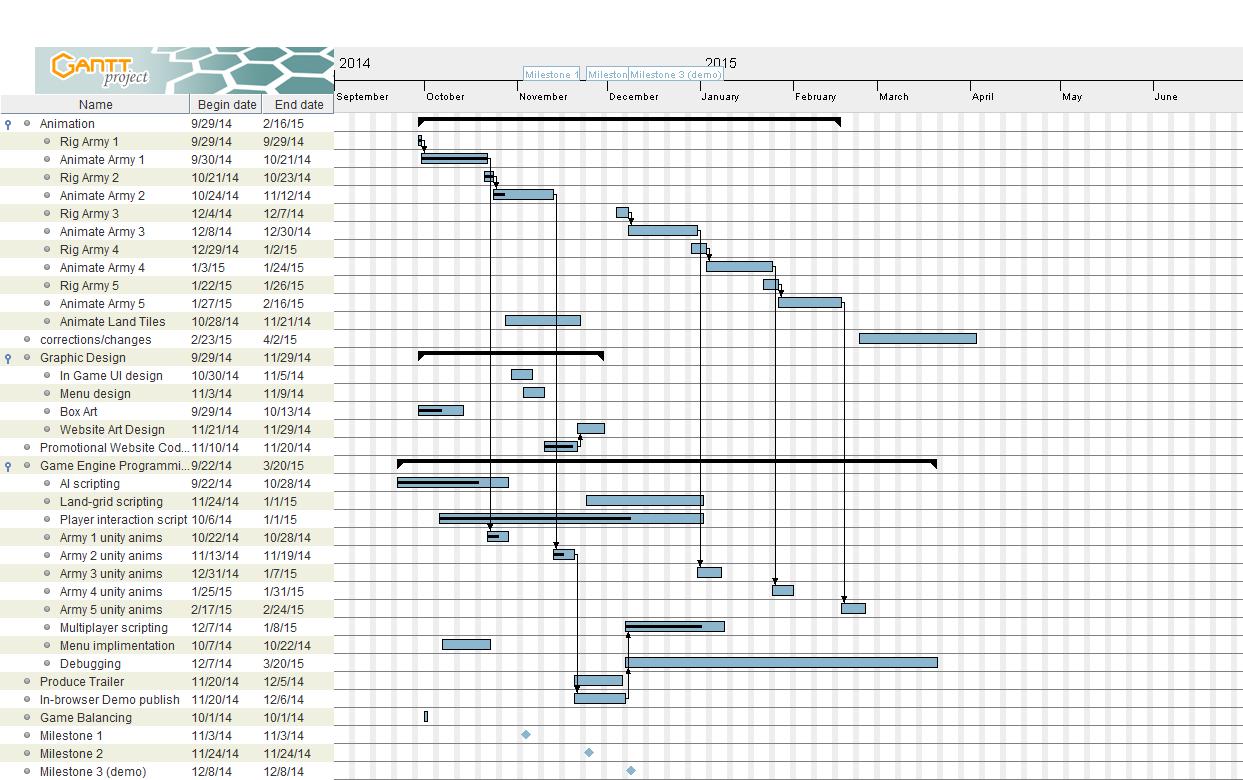
initial proposed schedule for Tiny Tactics

Promo art for New Media Night exhibit

Early in-Game screenshot
Annotated Bibliography
Ankama.”The Professions – DOFUS Devblog – WAKFU, The Strategic MMORPG with a Real Environmental and Political System.” Ankama Games, n.d. Web. 14 Oct. 2014.
A description of their proposed game features, including a detailed description of their professions and how one ‘harvests’ within the game.
Apple. “Apple – Press Info – Apple’s App Store Marks Historic 50 Billionth Download.” Apple, 16 May 2013. Web. 13 Oct. 2014. http://www.apple.com/pr/library/2013/05/16Apples-App-Store-Marks-Historic-50-Billionth-Download.html
A press release by apple celebrating their 50 Billionth app store download detailing several statistics they are proud of, including downloads per day.
Nelson, Brett. “The ‘Freemium’ Model: Top Flaws And Potent Fixes.” Forbes. Forbes Magazine, 23 July 2013. Web. 14 Oct. 2014. http://www.forbes.com/sites/brettnelson/2013/07/23/the-freemium-model-top-flaws-and-potent-fixes/
This article outlines the ‘freemium’ business model while describing its advantages and pitfalls, peppered with some advice for successful marketing within the model.
Unity. “Unity – Game Development Tool.” Unity. Unity Technologies, n.d. Web. 14 Oct. 2014. https://store.unity3d.com/


