I. A Link to New Media
When asked what I thought New Media was in NMD100, I was very literal, saying simply “media that is new to your generation”. Soon after when explaining New Media to friends and family, I talked about many-to-many communication, using eBay as my go-to-example. When designing my capstone, my take on New Media became more refined, combining previous expectations of what it meant to be a New Media project. New Media is created when an individual uses a piece of technology to express their idea in a unique, artistic way. New Media is art derived from science.
Interestingly, my projects had to become demos in Twine before I could see their New Media connections. While all of my experiments dealt with digital narrative, each looked at story telling from a different angle, using New Media to teach, remember, and inspire.
A. DRAG N DROP STORY
Growing up, I was a pretty good student. I was a year ahead int math, took honors science classes, and could name country capitals from around the world. I exceeded in every subject…except English. From 1st grade to my senior year of high school, I always felt like I was behind in English. I don’t know why for sure, but knowing how I learn best, I would assume English’s lack of visual and hands-on activities to be the culprits.
When I came up with DRAG N DROP STORY, I didn’t know that I would be creating this amazing piece of edutainment. The idea actually came from a video game, Scribblenauts. Scribblenauts allows uses to type in nouns to insert that object into the game. Recently the game expanded to allow adjectives. My favorite feature in video games is infinite replay-ability, so I was immediately drawn to the idea. Having worked with Scratch in NMD 102, I knew that puzzles were an intuitive tool perfect for showing connections and restrictions. The two features combined to create DRAG N DROP STORY and I soon realized that this “game” could actually be used to help children learn sentence structure while having fun creating stories.
I believe that DRAG N DROP STORY is important to the future of children around the world. Children would learn in the moment if they were able to instantly see when things did and didn’t work. No more waiting for the teach to check your work and try to explain why the errors they made were incorrect. The writing skills of children would skyrocket and the average age of authors would drop as the still creative children would be able to snap a few puzzle pieces together to create stories to share with anyone. I can see DRAG N DROP STORY having it’s own ebook store full of children’s fan fiction and dreams.
New Media comes into play by giving voices to the silent. Children to speak in an elegant way with nouns, verbs, and adjectives. They just should out the important ideas behind their story. With DRAG N DROP story, they can literally connect their ideas to form a story that can easily be communicated to anybody via the sentence itself or the animation that would created from the sentence.
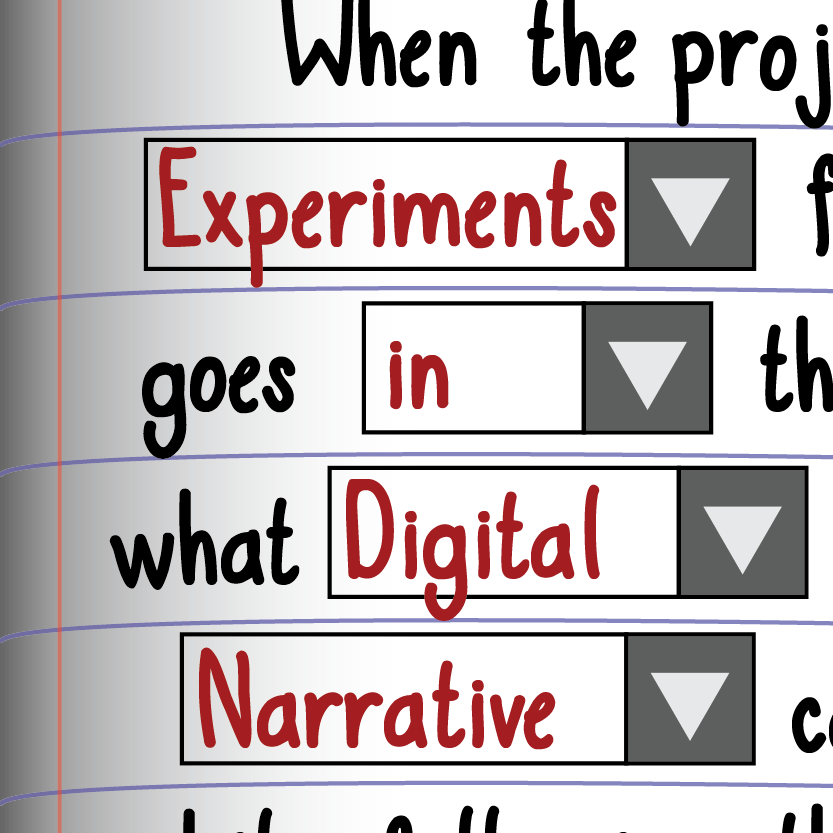
 Figure 1.1 - Example of DNDS puzzle pieces used to form a sentence.
B. RED RIDING HOOD
While I find DRAG N DROP STORY to be important, I find RED RIDING HOOD the most fascinating. The idea is to use New Media to take a glimpse of alternate realities. How so? I’m sure everyone has had one of those moments where they see a movie or read a book, and think “Hey! I just thought of that” or “I just dreamt about that a few weeks ago! I could have been rich by now.” It makes you feel kind of sad knowing that had you had more ambition or thought of it earlier, you could be rolling in dough. But the truth is, any story that will ever be written, every award winner, could be written today, it only takes the right person with the right experiences presenting to the right audience.
The idea behind RED RIDING HOOD is that the user is presented one widely known story and given the opportunity to change parts they don’t like. There choices will be based on how they were brought up, knowledge of how events play out, relationships, everything they have ever experienced. As the creator adds more options, the possible outputs rises exponentially. So had Little Red Riding Hood never been written, how many people would have written it from their experiences? What would your version of the story looked like?
New Media is suppose to grant people freedom. New Media is about drawing from the soul of a person, defying their limitations. If I can’t play a guitar, drums, and piano, I shouldn’t be forced to let go of that song I made in my head while daydreaming. It’s through New Media tools that I am able to mess around with digital recordings on my computer to create that dream tune. I see RED RIDING HOOD as a way to show people how they have been shaped by their life. Without writing a word, they are able to tell their story, by telling another story. It’s a beautiful idea.
C. STAINED GLASS STORY
Children have the most active imaginations, simple fact. They don’t require a VR headset or special gloves to be in another world, they just take an idea an expand upon it until their universe is greater than Star Wars or Lord of the Rings..and then the next day, they do it all over again. They aren’t tied down by worries. There’s no “experience congestion”. They are limitless in ideas, only requiring a way to materialize them.
STAINED GLASS STORY is essentially a way to capture excerpts of every child’s unique folklore. With the program, they are simply asked to choose a hero, a villain, and an event to happen between the characters. The output is a coloring book image that has been inspired by stained glass art. Shapes of characters are apparent to those who look had enough, but without color, it is up to the user to decide when one thing begins and another ends. It’s the tiniest spark in hopes of generating an inferno of ideas from the children. Where will they place the characters? What backstories will they create? Will they piece together new characters? Then with a few more clicks, they can print off a new scenario and add it to their story creating a commemorative coloring book of their lore.
As a New Media student, I strive to use technology to hone the natural skills found in people. This is why two of the three experiments I presented focus on children, because of their infinite potential. Their imaginations are never ending, but they need a way to collect these thoughts if they want to communicate with world. STAINED GLASS STORY takes something that would be forever lost after a nap and brings it to life for the world to see. It’s a diary for children’s imaginations if you will.
There are two parts to New Media: 1. Creating the tools for idea creation and expression. 2. Getting people to about their world from another perspective. When you can create a project that gets people to create new things that they’d never thought about, you doing New Media right. I did New Media right.
 Figure 1.2 - Image of a wizard fighting a prince from SGS.
II. Successes and Failures
Was my project a success or a failure? It’s hard to tell. I feel like I addressed real problems and got people thinking. Since day one, I had interest in DRAG N DROP STORY people wished they had such a tool when they were younger. At New Media night, people acted like I blew their mind with RED RIDING HOOD, and others found the idea of capturing the ideas of children with STAINED GLASS STORY to be “adorable”. However, all three experiments relied heavily on my explanation as none had enough work done to give people the true experience. It feels like I had six months to think about what New Media meant and only two months to execute three projects.
A. Success
I think it was a success judging by the meaningful uniqueness of my experiments. I created the plans for three ideas that had never been done before and showed people what it really meant to be New Media. I thought beyond using technology to do something that looked cool, I made things that made people think. If I could get a good temporary job and save up some money, I could potentially make A LOT of money off of these ideas in the future, but I would still be happy one teacher at capstone night decided to use a basic DRAG N DROP STORY in their classroom.
My capstone received mainly positive feedback. I only had one elementary teach say she thought I was aiming too high by using STAINED GLASS STORY on 4th and 5th graders. Everyone believed DRAG N DROP STORY had a future in schools citing the the constant change in teaching styles as an easy way to get my foot in the door. I had couple of English teachers (elementary and college) actually offer their classrooms for experimentation. I think RED RIDING HOOD and STAINED GLASS STORY may have gone over the head of a few of the guests, but everyone liked to color.
B. Failure
I feel like I failed by not presenting a “ready to ship” product. I really wanted DRAG N DROP STORY to work last semester, and was very embarrassed when I had to tell people I changed my capstone. While I know I had much less time to put things together, I still feel like I need to show as much at capstone night as everyone else. Unfortunately, there were many things that I didn’t even get to do for the demo. For example, I had some drawings of the characters I was going to do in the DRAG N DROP STORY animations, but ended up focusing on creating coloring book pages for the event so people would have some sort of physical take away. I had also meant to digitize all of the images I made for the RED RIDING HOOD, but in the end, decided they weren’t as important and focused on other items.
Part of my failure also came from a lack of saving. Not once, but twice, I lost chunks of STAINED GLASS STORY. Why? I’m not sure. Twine only saves in your browser, so as long as you don’t clear your history and caches, it saves automatically. For some reason, Twine refused to save items every so often so I wound end up with passages that contained both old and new text. I learned to save proofing copies of my twines for easy restoration, but that mistake cost me a few days of work when I only had two months or so to begin with.
 Figure 1.3 - Drawing of characters meant for DNDS animations.
C. Conclusion
The bright side of this situation is what came of my project by failing DRAG N DROP STORY. Like a phoenix rising from the ashes, DRAG N DROP STORY was reborn in the form of a Twine demo along with two other, what I find to be, brilliant ideas. While I would have much rather had a whole project to show, I am appreciative of the ideas failure gave me. I can’t blame myself for my failure of the full version of DRAG N DROP STORY as I don’t know what I don’t know and could not have predicted the issues with the RFID reader.
I learned not to strap a couple of fireworks to my back and hope to shoot to the stars. When I started my capstone, I thought that by using Processing, I would be able to bring my idea to fruition. I have worked with Processing every year since my first semester and have made all sorts of perfectly fine New Media projects. My error was trying to use this little program to do something I’d never learned in class. DRAG N DROP STORY required so much coding that certain parts were unable to keep up. Online forums yielded no solutions, or at least none that I could understand. Given more time, I may have figured it out, but I was in a class, so I was on a strict schedule. When I attempt DRAG N DROP STORY in the future, I will do much, much more research into what would be the best program to use and invest time into learning it and taking notes.
Twine isn’t the best format to show DRAG N DROP STORY, but it served as a good demo and actually worked rather well for RED RIDING HOOD and STAINED GLASS STORY. It’s possible that RED RIDING HOOD may have found its permanent home, Twine being made for hypertext stories after all. In my free time, I could easily come up with an alternate ending here and there and maybe in the future I could have story with a thousand different endings for people to explore. STAINED GLASS STORY would only require content creation(stained glass images) to become fully fleshed out, so a testable classroom version would be possible by next year.
Appendix A: Annotated Bibliography
Puzzle of Life: A small business product. Customizable puzzle piece shaped picture frames. These frames tell a story of how people and places are connected, my project will tell other stories in a different way.
Scribblenauts: A video game that portrays/brings to life almost any noun and adjective enhanced noun the user types out. My project will be much more limited in the number of usable words. Users will be presented will all usable words in the form of puzzle pieces. My project will also use verbs and prepositions.
Scratch: A programming learning tool for beginners. Hierarchy is shown through puzzle pieces. My project will also show connections via puzzle pieces.
Learn to Read: Website that teaches children how to read. Text accompanies videos. Unknown words can be clicked on for children to hear it sounded out.
Jigmania: Snow White: The user solves puzzles to reveal the next page in the story. My project will use puzzles to teach and make the stories.
Story Writing Game: A very simple mad lib style game. The user chooses a type of story. Each story has words missing that are associated with the type of story. The user must choose the missing words from a word bank to finish the story.
Fair e-Tales: Three enhanced fairytales that give the user a different perspective on the well known events. The purpose is to get people thinking about why stories are the way they are and to inspire people to think about the chaos effect of small changes. Not only will I be using a fairytale in my project, but I, too, will be looking to get people thinking about how perspective changes what we have known since we were children.
Paint by Numbers: Special coloring books and paint kits where interwoven shapes are assigned numbers, by paint all shapes with the same number the same color, a recognizable image is produced. My third experiment will basically get rid of the numbers so children may interpret images the events they created however they wish.