Reflective Article

Summarize the Evolution of Your Capstone

Looking back on capstone, it has been quite the journey. The adventure began towards the end of NMD 306, when we began brainstorming ideas. In that moment we were intimidated by the capstone process and were eager to come up with a solid idea. As New Media majors, we wanted to design and implement a project that is new, exciting and innovative. At first, we had a vision to create a Study Abroad app or website that would assist students that are traveling in Europe.  After brainstorming and designing a potential travel app, we realized that it would be difficult to test the app in Orono because not many students study abroad. We also wanted to create a project that benefits majority of students on campus. After that idea quickly failed and went down hill, we were forced to come up with a new one.  We then started to consider different ideas and possibilities for our capstone project. We took the time to think about the issues students have over the course of the college experience here at UMaine. We both simultaneously agreed that housing was one of the major difficulties student’s deal with year after year and we knew a more reliable resources is what was needed.

  After weeks of brainstorming different ideas, the development for Livin’ Easy began mid September 2014. Once we had a mutual goal in mind, we started to think about things we disliked about Orono or issues we had on and off campus. One day we were browsing through airbnb’s website and thought about how Orono’s community and students would benefit from a housing website that could connect all of the current resources into one. Throughout our college experience, we have had countless issues when searching for off-campus housing within an affordable budget. The issues we have experienced deal with the fact that there are no efficient housing websites for students in Orono that stay maintained or up to date. The housing websites that do exist are poorly designed and are not effective in assisting students with locating housing. After years of dealing with these issues and talking with dozens of students, we have found that everyone agrees students lack a single platform or website that would allow them to search a single database that contains all of the listings in our local area. After a few years of dealings with these issues, we decided that the Orono community could really benefit from a quick, convenient housing website. Throughout our capstone, we have experienced both moments of struggle and moments of success. Livin Easy has come a long way in the past 8 months, and ultimately we are satisfied with its outcome.

For our capstone specifically, promotion and advertising was a huge part. One large issue that we ran into during the promotion phase was advertising in the freshmen dorms. We set up a meeting with the head of Residence Life on campus and pitched our capstone project, requesting to use advertise in the freshmen dorms. Although he loved everything about our project, he said that it was competing with the school and their intention of keeping students on campus. At first this was quite the barrier put up in front of us as we figured a large part of our target audience would be students looking to leave campus, so most likely freshman. Although we were disappointed and somewhat frustrated with the news we received, we accepted it and worked worked around the problem and figured out another solution. Our solution was simple yet effective. We created short surveys that we asked freshmen/sophomore students to take. Some people filled out the survey when they visited our advertising stand, and others filled it out online on their own time. We also encouraged our friends and neighbors to take our survey and also test it out for themselves. We were very satisfied how people responded to the questions we had. There were both positive comments and negative comments, that all equally contributed to our overall website.

Although we weren’t allowed to advertise in the freshmen dorms, we took advantage of advertising in the Union. The Union was the perfect place to advertise because there were plenty of students and faculty walking across passing our stand. We set up our project at a large table across from the bookstore. We displayed our large information poster and promotion video so students can get a better idea about our website. In addition, we created a survey that we made available for students to take.  The feedback was extremely helpful for our progression on our capstone.  Most of the feedback was directed towards adjusting the price slider, adding reviews from students and adding more apartment listings. The biggest criticism we had was that students wanted to see reviews of previous places so they know if the previous owner had a pleasant experience.

As a team, we are happy that we were able to create a fun and accessible website that students can really benefit from. The feedback that we gathered from our capstone was extremely beneficial in the process of adding and adjusting our website. Since our website is almost entirely directed towards students, we really valued their opinions and contributions to our website. Capstone has definitely taught us to push through our problems and figure out solutions, no matter how difficult the situation is. Below is a flowchart we created in the beginning of Fall 2014 that shows our steps in the overall process of creating our website.

Access your capstones successes and failure

Throughout our capstone, we have experienced both moments of struggle   and moments of success. Livin Easy has come a long way in the past 8 months, and ultimately we are satisfied with its outcome. As a team, we have learned and progressed from our own mistakes and failures. After struggling with the early development stages and learning how to code our own website, we soon learned that capstone is a huge challenge. A huge and very underestimated part of the capstone process is first coming up with an idea. From the beginning, we knew that we wanted to create a website or app that benefited students, however, it took a lot of time and thinking to come up with a solid capstone idea.

Coding was a huge struggle for us early on. During the beginning stages of developing our website, we experimented with HTML and JSON to create a working homepage that functioned with basic styling. We were not happy with the outcome of our first layout. After experiencing failure, we tried a different approach and designed a new and more detailed home page for our website using HTML PHP and MySQL. Although the page we created worked and functioned the way we wanted to but we started running into issues solving coding problems. We also ran into a problem where our homepage took a while to load and also enter in information. After two months of coding and designing ourselves, we realized that we needed to take a different approach to creating the website. Our professor Joline, suggested that check out WordPress and see if that could be an option. After watching tutorials and asking Joline a lot of questions, we were able to start building a solid website that has the look and functions that we wanted to see. From the start we had a vision in mind for our housing website. We wanted our housing website to be fun and upbeat, with bright colors, pictures and visuals and a parallax scroll. Although WordPress allowed us to be creative and upload content we designed, it didn’t always work the way we wanted it to. We ran into issues and problems when getting our home page slider to work and function and we had issues adjusting the price slider on the home page.

Feedback was definitely a huge contribution to our project. Student’s opinions, suggestions and contributions significantly changed our project for the better and this type of feedback is what will always keep the site changing to fit the needs of its users. Faculty member’s help was also a huge contribution to our project. Although student’s opinions are important, New Media faculty members gave us constructive criticism and suggestions as to how we can make our project more powerful and effective. Another issue we ran into was getting in touch with landlords. Although we were in frequent contact with Chad Bradbury from KC Management other landlords, Dennis Cross from Cross Properties did not respond to emails as often. Chad Bradbury provided us with the most apartment listings on our site and he told us that there are more listings to come in the next few weeks. We were very pleased that almost all of the landlords in the area want to jump on board with Livin’ Easy as it would be free promoting for them. As New Media students, our goal was to create a capstone project that creates a unique and futuristic experience for our users. We had to make mistakes and fail in order to succeed with this capstone project. In the beginning we struggled and in the end we struggled, but with each problem we learned something from it. Overall, we felt that our capstone was an experience where we were able to apply our New Media skills to something we are passionate about and we have built something that we can continue to grow and expand as the future goes on.

Annotated Bibliography

https://www.airbnb.com/

http://www.zillow.com/Zillow Group is an online real estate database company

http://www.apartments.com/

http://www.bluehost.com/ – Blue host is the web hosting site that we purchased to host our website

https://maine.craigslist.org/

First Class (Apartment Folder)

Reflective Article

Evolution of Capstone

From the very beginning, the core concept of my capstone project revolved around flight. At first I was planning on building a prototype “cockpit” that the user would sit in as if they were flying a real plane. With the use of an Oculus Rift and a realistic flight simulator, I was going to create an immersive experience that made the user feel as though they were actually flying. However, one day in class, as everyone talked amongst themselves, I sat there wondering if this would truly give me the sensation of flying, or if it would turn out as some gimmicky toy which I would never use. As if a lightning bolt pierced through the IMRC and struck me in the brain, I was electrified by a new, more immerisive, more impactful idea, the likes of which had never been attempted at the University of Maine. I would take a controversial technology that I was passionate about using, UAVs, and bring it into the spotlight, opening up the accessibility of this tech, as well as spreading the word about the potential positive benefits it could bring to every industry imaginable. Right there and then, UAVAcadeME was born.bebop

But how? How do I get something like this off the ground. I had previous experience with UAVs, but I was certainly no professional. I began researching everything I could on how they worked, the different projects people were using them for, and the regulations, the vague, overbearing, and growth stunting regulations set forth by the FAA years ago. I decided I would create a group on campus that would allow students access to quality UAVs, teach them the safe and proper way to operate them, and when the students were well aware of the risks and rules about flying them, allow for free use of the technology, much like the CML does with cameras, so that innovation and creativity could meet. There was just one last thing I hoped to accomplish. I wanted to create a partnership with ASAP, New Media’s research and development group. If I could get them on board with the idea of using the UAV’s from UAVAcadeME to do research on involving micro-controllers and other sensors, the credibility of this project would fly through the roof, raising the probability of receiving funding. Umaine could start doing serious work with drones and their potential uses, and students from all fields of study would be able to experience this technology. With my ducks all lined up neatly in a row, I approached Mike Scott, head of ASAP at Umaine, thinking he would be intrigued by the idea. I was sadly mistaken. Instead of intrigue, I felt as though I was met with rudeness and disrespect. I was told the project had nothing to do with New Media, that I was wrong about several aspects regarding UAV regulations(which I was in fact correct about), and that Umaine was already doing enough with UAVs anyway.

I left Mike’s office completely dejected, wondering why someone in a position of authority like that would be attempting to put a student down, and how he didn’t see the obvious positive potential this project had. However, having come out the other side of the capstone process, I am extremely happy Mike acted and spoke the way he did, for if it wasn’t for that interaction, which I feel is the defining turning point in my capstone project, I probably would not have been as successful in completing this project as I have been. Now looking back at one of my first classes with Mike, I recall him focusing on “road-blocks” and how they are just as important to projects, if not more important, than successes. Perhaps Mr. Scott’s final lesson for me was having himself be that ‘road-block’ standing between me and my idea coming to fruition. If so, well played Mike. In a strange, twisted way, you’ve been an integral part of my capstone experience.

Moving on from my failure to make a partnership with ASAP, as well as other difficulties implementing UAVAcadeME such as proximity and financial struggles, I had another revelation, almost equally as important as the idea to work with UAVs. I would scale down from the University setting, and instead bring this technology to High Schools. This idea actually arose after I was thinking about how if I had been exposed to UAVs before college, perhaps I would have started out a New Media student, instead of switching from Chemistry one and a half years in. I approached the technology coordinator at Wiscasset High School, where I graduated from, and received a reaction I couldn’t have imagined. She was completely blown away and thrilled by the idea. After speaking with a few teachers, I knew that this was the true home for my project. I had gone full circle, and ended up right back where my education began. Surrounded by those that had watched me grow and support me, I was able to make this project more impactful than originally intended.iPhone Image 42CF27

At first I had hoped to simply show people how to fly a UAV, then let them use it for their own projects. Although this is a nice and altruistic concept, there isn’t much information being transferred, other than how to move this robot in 3d space. Now, in the setting of a High School, I was given a much more structured framework I could work with. The goals transformed, instead, into teaching the actual science behind how these things fly. From gravity to wind resistance, amps vs. watts vs. volts, electrical and mechanical engineering, I started developing a rough lesson plan for a theoretical UAV class. All of a sudden the theoretical class became real. Students will learn the core concepts about how drones fly, learn how to build them using techniques such as wiring, soldering, and software engineering, and be given a clear overview of the current and upcoming rules and regulations governing the US airspace. I have been told there is funding available precisely for creating new STEM classes, and there are already several students signed up for this class, requiring the school to split it up into two sections, one in the fall and one in the spring. UAVAcadeME started as just a silent idea in my head, and through some struggle and adversity, I was able to find a useful and exciting place for it to blossom, manifesting itself into reality.

The Future

The future of my project looks incredible. With so much support from the Wiscasset High School I’ve already had to do a lot of brainstorming as far as where the next steps of this project will lead me. Depending on how the class turns out, more funding opportunities are available from one of the major UAV creators in the business, 3DRobotics. This company has pledged to help University and High School educators get their “”Drone programs” off the ground with funding, training, information and more. After verifying the success of integrating this class into the curriculum of the first pilot school, Wiscasset, I intend to spread out in the mid-coast area. Other schools will no doubt be interested in acquiring the same technology, and perhaps even use the framework of Wiscasset’s class in order to design their own. Of course, I will attempt to work with each school as they adopt UAVs into their classrooms, and hopefully create connections between each of the schools, allowing students to interact with other students from other schools, increasing innovation in the UAV sphere. The hope is that all projects developed by the High School Students will be posted to my UAVAcadeME website, creating a central hub for Maine UAV-based projects.

It’s pretty clear that my intentions are to create a career out of UAVs, and educating others about them is the first step. Since the Wiscasset High School wants to hire me to help teach this new course, I am already gaining credibility when it comes to UAVs. When the clear-cut rules and regulations are set forth by the FAA, I will be attempting to become certified in whatever capacity is necessary to operate UAVs commercially. This could lead me into many different industries, and hopefully I will be a pioneer of UAV use to all of them. But a potential career isn’t the only reason I continue this project. Surprisingly, I was truly able to spend my capstone class exploring a topic I was genuinely passionate about and intrigued by. I imagined how awesome it would have been for me to have access to this technology and information while I was in High School, and I was driven to make it a reality. Forget about making money, forget about getting a good grade in NMD499. Something inside me is compelling me to accomplish this goal. That inner drive and sense of self-worth is the reason I am continuing this project…And because UAVs are totally awesome!

Annotated Bibliography

http://dronelife.com/

Great source of information on different UAVs and how they work.

http://dronelawjournal.com/

This site covered a lot about the laws and regulations concerning UAVs.

http://www.maineimaging.com/aerial-video/

A company in the town that I live which mentions their interest in using UAV tech, but notes that they will not until clear regulations are in place.

https://www.faa.gov/uas/

The FAA’s website which explains where the regulations are currently in place. A little difficult to sift through.

http://www.tested.com/tech/460662-testing-dji-phantom-vision-quadcopter-drone/

Tested is a great online source for info on new UAVs and they expanding tech that they are fitting into these machines.

Tiny Tactics Reflective Article

By Scott Forand

Evolution of Tiny Tactics

Tiny tactics didn’t start out as a project for the University of Maine. If fact, I was very close to giving up on graduation from UMaine as a whole at the time. I had run into financial problems roughly four classes from graduation, and a combination of student loans and general life bills suddenly made returning to school an unlikely event. It was at that point that I decided to circumvent that system and find my own way into the video game industry: /r/gamedevclassifieds, a subforum on the website ‘reddit’, dedicated to game aspiring and professional game development job placement.

I discovered a posting by a programmer, Matt Favero, who had a limited demo of a game he wanted to see come to fruition. It was rough, but I saw potential in it. After a brief auditioning period, I was signed on to the game project and we continued work on it from that point on. Initially, it was a top down styled game with very little to it beyond selecting one static image and moving it in opposition to the opponent’s static image, all done in traditional programmer art (which is to say that it wasn’t the prettiest game to look at.)

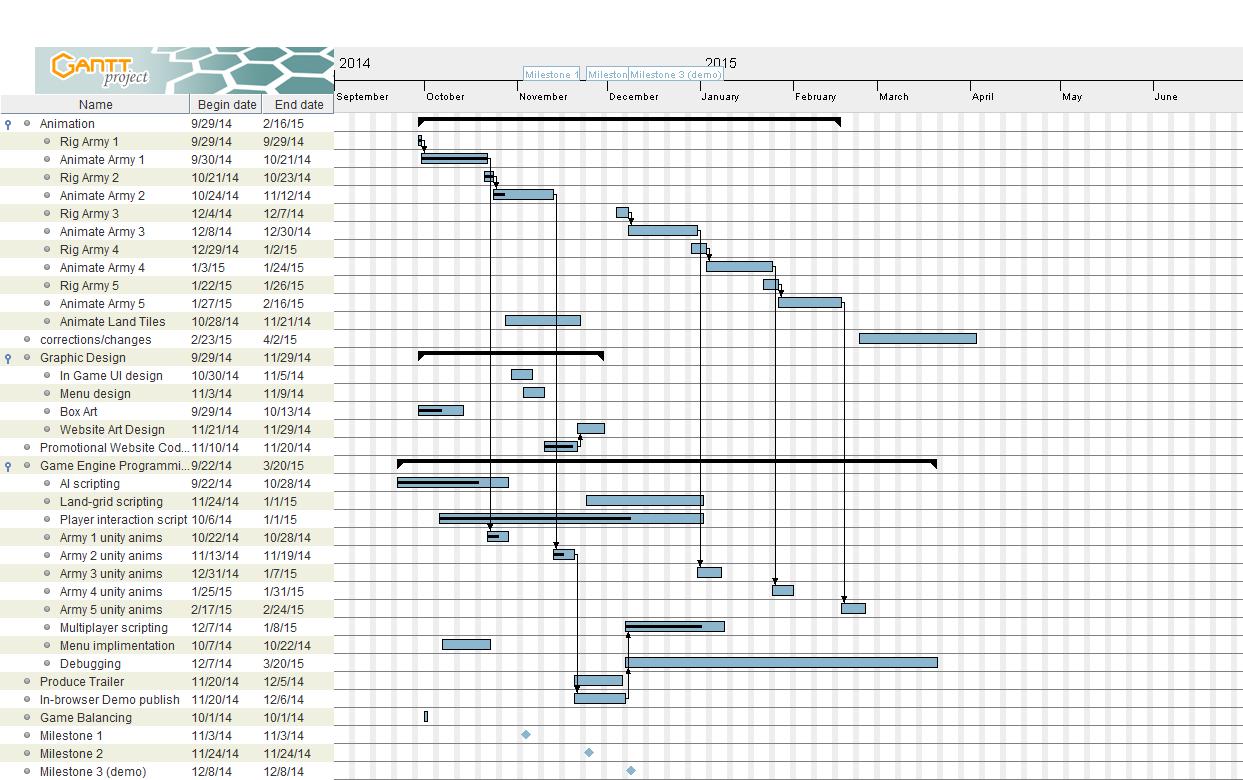
With any video game, the initial concept of gameplay is always fairly quick to generate. The final output is still a work in progress however, as our look on the game changes as more people test it and features are added and removed. Our initial approach (as referenced in the Gantt chart below) was a slow, methodical approach, knocking out features in their entirety, one by one. We learned a few months into the game’s acceptance as a New Media capstone that this was not in our best interest. Instead, laying out a bare-bones ‘test case’ scenario worked much better for demonstrating what we intended to accomplish – without spending overmuch time on asset generation.

The inclusion of a research aspect to the game was an unexpected turn, but it introduced a potential dynamic element into the online game-play that we found appealing. Much more work is required to actually realize the plans we have set in place, but the potential for expanded, engaging game-play is palpable, and I look forward to future progress in that area.

Successes and Failures

Tiny Tactics has progressed leaps and bounds since it’s initial stages. A quick look at the footage of the original game will be enough to explain the graphical improvements. As the sole artist on the project, I’ve been using the knowledge I’ve picked up along the way to improve the overall game feel and design, not just on a surface level but down to some of the more structural areas, such as user interface and game-flow.

Our initial game concept lacked any competitive game-play aspects beyond pushing pieces across the game board, so the inclusion of the dynamic board elements and the establishment of a decent back-story provides a much more solid foundation to build off of in regards to creating a captivating play environment. When this is combined with the potential for playing with many others, towards a common interest, the game takes on an even more compelling form.

This is not to say that the game has been one success after another. Video games suffer from two common areas of complication: The development software and the sheer amount of effort and time needed to produce even minimal returns. Being first time developers, my programmer and I underestimated the time it would take to produce and field the number of assets and changes necessary to make our game a fully produced demo. Where we had initially planned to have all four armies produced for play, time constraints have reduced that to two.

Unity, our game’s development platform, received a massive update mid-way through spring semester, which incorporated all the tools we would have otherwise had to buy into the free version. While this sounds like a victory, it necessitated a full re-write of the game to take advantage of those tools – a large setback in progress time. As of the writing of this article, we have just started to make forward progress on the game again.

Moving Forward

I started working on Tiny Tactics long before I ever even considered using it for my New Media capstone. Producing this game is important not only to my future in this buisness, but for proving to myself that with enough motivation and effort I can in fact do something of this scale. Progress will continue on Tiny Tactics until it is a full, polished game; Perhaps even beyond that, because when you work so hard on a project that is important to you it becomes part of you, and I’ll be satisfied with nothing less then my best showing.

Figures

Tiny Tactics Schedule

initial proposed schedule for Tiny Tactics

TTBanner

Promo art for New Media Night exhibit

TT

Early in-Game screenshot

Annotated Bibliography

Ankama.”The Professions – DOFUS Devblog – WAKFU, The Strategic MMORPG with a Real Environmental and Political System.” Ankama Games, n.d. Web. 14 Oct. 2014.

A description of their proposed game features, including a detailed description of their professions and how one ‘harvests’ within the game.

Apple. “Apple – Press Info – Apple’s App Store Marks Historic 50 Billionth Download.” Apple, 16 May 2013. Web. 13 Oct. 2014. http://www.apple.com/pr/library/2013/05/16Apples-App-Store-Marks-Historic-50-Billionth-Download.html

A press release by apple celebrating their 50 Billionth app store download detailing several statistics they are proud of, including downloads per day.

Nelson, Brett. “The ‘Freemium’ Model: Top Flaws And Potent Fixes.” Forbes. Forbes Magazine, 23 July 2013. Web. 14 Oct. 2014. http://www.forbes.com/sites/brettnelson/2013/07/23/the-freemium-model-top-flaws-and-potent-fixes/

This article outlines the ‘freemium’ business model while describing its advantages and pitfalls, peppered with some advice for successful marketing within the model.

Unity. “Unity – Game Development Tool.” Unity. Unity Technologies, n.d. Web. 14 Oct. 2014. https://store.unity3d.com/

Article

Part of my capstone idea actually originally came from a non computer based idea which was shown to me while I was playing disc golf. There is a tag system at a course where you buy a custom tag with a number on it and make it visible on your bag. If you see someone with a tag on their bag and they have a higher number than you you can challenge them to play for tags. If you win you get their number and if they win they keep their number with the higher the numbers at the end of the year getting higher pay-offs. This system however is not likely to work well because there is no making sure higher number players bring their tags and there is also no guarantee you will just happen to end up at the course at the same time as a higher tag player after a certain amount of winning.

My fix for that would be to have players with tags give the course their phone numbers or emails and the most likely times they will be able to play. By doing this, tag members would have an opportunity to actually challenge people through simple communication rather than hoping to run into another tag player by chance. There could also be some sort of requirement for every tag player to play a challenge every week or two to keep the tags in rotation.


This lead to me trying to develop an app specific to disc golf players that would allow them to challenge each other and win points based on the skill level of the people they’re playing against. The app itself would let users send out invitations to challenge other disc golfers near them, which will hopefully expand the community and heighten awareness of the sport. However I came to realize that I wanted to use my capstone to highlight my web skills in order to build my portfolio for potential employers. With that being said I still really liked the idea of bringing disc golf to a more social level.


At D.R. Disc Golf in Orrington there are things called pilot numbers that you can get only after recording 20 or more games at the course. The pilot numbers allow you to compete in their weekend tournaments, get discounts on discs, and have your handicap recorded. As of right now there are over 500 pilot numbers out after the course opened 4 years ago. The average disc golfer knows and plays regularly with around 10 people. If we take that information and use it to figure out how many people in this area play disc golf we’re looking at around 2,500 people who play disc golf and probably in-between 1,500 and 2,000 people actively playing. Sometimes people are left having to play by themselves when no one else is available when there are so many other players willing to be challenged. The goal of DGS is that people would be interested in challenging themselves more and meeting new people without having to participate in a formal tournament type of match.


With that being said, there comes the issue of getting the equipment you want without spending a lot of money. Granted disc golf tends to be a tenth of the price of regular golf, however that appeal may be what attracts people to the sport in the first place. DGS offers a craigslist-style trading system allowing players to negotiate trades online or at their local course. Lastly DGS sets out to allow players to know where the courses in their area are. Without extra funds to promote themselves, disc golf courses are often left unnoticed by the community and this site sets out to help players discover all the courses in their area, but also to let them know the ones that would suit their play style the best.

Poster-landscape

LOGO

My design standpoint of the website was to keep it very clean and modern looking. I have a style that is kind of bold bright and clean which I think I used effectively to create a good looking and easy to use interface. Although the site is still in the beta stage I have been testing it with other disc golfers, the feed back from whom Ive taken into account and sort of expected. Basically my user testing involved people registering, adding posts, and trying to find things on the website then letting me know what was buggy or not functioning in a well designed way. The feedback was as expected, basically that some of the filtering of posts could be more in depth, images are a little blurry on posts, and single pages need to be better laid out. Positive feedback said that the website was involved and easy to understand and use, however the user search was not working.


Disc Plus

Disc Caddy

Flight Analyzer

The Disc Golf Challenge

These are four different existing apps that all do different things related to disc golf and I want to incorporate some features from each into my website.

DG Review

This site is basically what I based my course listings on

Code Tuts Tutorials

This so far has been a great resource for helping me get started on web desgin

Lynda Tutorials

I will need to buy a subscription to watch these tutorials but in my experience Lynda tutorials have been very good and they have two different tutorials on developing wordpress themes.

McPeakdesigns – Reflective Article

Hunter McPeak – McPeakdesigns.com

Summarize the evolution of your capstone

For myself capstone was more of a maze and a journey rather than a straightforward path. This path took me down many roads of failure as well as many roads of success and understanding. Thought my years at University of Maine and in the New Media Department I thought of capstone as something that had to be changing to the world around me, but when it actually came down to it, I found out it was more of a chance to showcase what I wanted to do with a degree in New Media.

Initially in the fall of 2014 my goals were straight and the plan for my capstone was to make a mobile app that connects people to events. It was called “Poppin”. Poppin a social media app that was originally made for college students to invite a delegated amount of people to their parties without them getting too out of control. I still love this idea an may pursue it in time, but another opportunity arose that was much more practical for me and my life after college. This opportunity presented itself and was called “Liberty Farms.

Liberty Farms was a small start up year round all organic produce company that was started in Falmouth Maine. Their mission was to bring people in the surround area with fresh produce year round. With contracts such as Portland high school, and Hannafords already secured, I thought this start up was going to be an amazing success. It was my job to develop a logo, website and potential mobile app for this start-up company. Over time with the lack of communication and resources to build a functional site from, I left the project and took a trip to San Francisco.

In San Francisco I showed family what I was working on in school and through sheer word of mouth I was able to gain two immediate contracts and another potential contract post graduation. The first contract was for a consulting company known as Wigioadvisors. The second is Hallie Wine consulting and the third and only potential big contract is Bass Electric. 

Wigio already had a site and logo, but was looking for something new and refreshing. Although they still wanted something along the lines of what they had, they did want a new smoother perspective on their site with some added functionality. The other client was Hallie Wine Consulting which is also post graduation, but a sure contract that will result in actual cash flow. Although I had these contracts secured, these were not the only part to my capstone.

Once I returned I spoke with Joline and the direction which we decide to take was an actual portfolio/business that could showcase all of these sites and logos that I was building or currently working on. From there I thought of the concept mcpeakdesigns. Mcpeakdesigns is the title of my online graphic arts portfolio/business and actual personal blog site that shows up to date what I am working on. It consists of any range of materials or work that I have done over the semester including the three additional sites that I have built (Wigio, Peachwave, Liberty Farms). These designs and sites are another example that further shows my evolution as a graphic designer and business minor. By looking at them you can see that my feel for aesthetic appeal and design has progressed as well as my knowledge and understanding of servers and wordpress itself.

Plot a future for your capstone

When it comes to the future and dealing with McPeakdesigns, it could be extremely useful and helpful for my career choice. I one day wish to own an actual business and this experience has been extremely insightful when it comes to learning how to handle a small start-up. I needed to learn about servers, easthetic appeal, interacting with clients as well as taking advice. A lot of people think that their idea is just going to work, but something I learned was that you are going to hit roadbumps and sometimes your ideas will be rejected. So having numerous sketches/sites being rejected was an extremely useful thing for learning how to adapt to clients for the future. As for the actual future, I have thought about it and I am considering a name change as well as a site overhaul. Although I like the design currently, I think I want to make some changes to it and make it brighter and more eye catching. The simplicity works and the clients that I have talked to like aspects of it, but as for the actual site I wish to make some changes. Although the futures of the site is unknown the projects are certain. I have gained two contracts that I am going to begin to work on in the near future.

The first and smaller of the two is Hallie Wine Consulting, which is a smaller wine consulting business that specializes in bottling and distributing wines from the Bay area. With this contract I will be paid for developing a website with email as well as a log and business cards for the start-up owners Sandy Roberts and Heather Whiles. Through all of the research and information gathering I think this process will be extremely fun because of the sheer amount of connections that each wine consulting company has to another. The complexity wont be the hard part, it will be the actual information and getting what I need to make a successful site. Although Hallie Wine Consulting is an upcoming project its not my only project. The next project is a big contract that would involve a lot of redesigning for big electric company in San Francisco. The company is called Bass Electric and though their site is not bad, they wish to make a jump forward and switch to a wordpress platform so they can optimize and change their site without consulting an outside source or who actually built their site. Although Bass electric is not as urgent or as sure as Hallie, the future is bright for McPeakdesigns considering the two contract via post graduation.

Assess your capstone’s successes and failures

When it comes to success and failures, every capstone is going to have them, but the mistakes I made were more along the lines of having to wait. When it comes to building sites one thing I found important was content. Content is extremely important to making a successful site and one thing that was extremely tough was actually getting the information. Over the entire time, I was struggling to get what I needed and that made progression extremely slow. Being understanding for small start-up companies is extremely important, but there has to come a point where you just say enough is enough and put fake filler content in and I understood that too late. Switching information and media would have been easy enough, but I didn’t think of doing that so my progression on a couple of the sites. So for me the biggest failure was actually getting what I need and pushing clients, which caused a lot of last minute additions. There were significant failures when it came to designing, but thats the beauty and best part of design is that you can go back fix your corrections and move onto the future. With mistakes you learn and thats something that I certainly believe in because I learned so much from aesthetic appeal and what people want from the failures I made as a young designer.

Some of the successful parts of my project were the fact that I was getting paid to actually do work, because 3 out of the 4 sites that I made in one semester actually paid me and the forth site was my site so I couldn’t pay myself. Another part I would deem successful would be the actual learning about all of the independent parts of what it takes to make a small portfolio/business site. You have to learn how to make sites, point sites host sites and such with a server. I knew nothing about how hosting domains and servers so to learn about them was one of the more important things that I learned during this entire process. Another thing that was pretty big was as I stated earlier, connecting with clients and learning how to adapt to what the people you work for need. It is different then an actual job because what they tell you has to be applied in order for you to get paid. Changing how you wash dishes is completely from changing and entire sites front page and the way a site looks. You have to learn how to adapt and implement what people want which was a big success for me because my clients were happy with what they saw, so much that I was able to stay and be paid to do the work that I enjoyed to do. My biggest success would be the fact that I got paid or am getting paid to do something that I love to do. Design and aesthetic appeal is something I love and focus on so to get paid to do it would be considered a sites in my book.

Conclusion

Overall I had an extremely enlightening time learning about what it takes to start a small business and graphic design portfolio. Through all of the switches and changes over the year I was able to keep it together an create something I actually believe is a viable New Media Capstone and something that will defiantly help me in the future. The only tough part for me with be moving from such a low level of experience to somewhere like San Francisco which is the #1 graphic design city in the world. Although this will be a tough challenge, learning and becoming the best that I possibly can will be maximized by moving somewhere like that.

Figures

LibertyFarms


Liberty Farms was the original site that kicked off this entire adventure of having a web hosting business

Peachwave


Next came the complete redesign and of the peachwave site that is owned by my father David McPeak.

Wigio


After Peachwave was finished I focused my attention of a small startup company based out of San Francisco which was called Wigio, an online advising company for ecommerce.

McPeakDesigns

Finally you have McPeakdesigns, which was the portfolio/business and web hosting showcase that could should people what I have made and all of my projects.

Annotated bibliography

http://www.bluehost.com/

Blue host is the web hosting site that I bought my server space though so that I could actually host all of the project that I do.


https://wordpress.com/

WordPress is the core and entire focal point of my project and without learning the ins and outs of wordpress I could not have made this project possible.


http://www.umit.maine.edu/~Jorge_Gonzalez/

I have to give credit where credit is due and I learned a lot about aesthetic appeal from my professor Jorge Gonzalez


http://www.squarespace.com/

I learned a lot of various platforms and another viable platform yet not my choice would be squarespace.


wigioadvisors.com

The original site before we launch our new site which is coming soon.


Thank you for the opportunity and enjoy your summer

-Hunter McPeak


Forestry Finder Reflective Article

Version:1.0 StartHTML:0000000167 EndHTML:0000013916 StartFragment:0000000487 EndFragment:0000013900

Benjamin Brown

5/3/2015

Capstone Reflection

Nmd 499

Summarize the evolution of your capstone

Coming from a family that has produced several generations of loggers it was almost guaranteed that at least one point in my life would be spent in the woods working by my father and brothers. This point has turned into several years in which I both worked as a mechanical operator, and as a full time student at the university of Maine. As such my view of interactions was colored by the fact many of the problems and operations that were always associated with logging could be solved in one way or another using emerging technologies. This became the focus of my capstone, and I believe that overall I have made a service that can help every level of infrastructure used in modern logging. Even at this point in time the services provided are quite expansive and have a great deal of room to grow and evolve based on the needs of this industry.

The concept for the Forestry Finder application was originally intended to be an app developed and released for android or apple mobile phones. Quite a large amount of research and code was printed to begin the work of producing it. Obviously this idea did not last into the later stages of creation as many individuals of loggers, and for that matter anyone who could potentially use this service, would not own the required device causing a very decisive schism within the potential market. Considering that a collaborative map would be useless if not everyone within a certain industry would be able to use it a workaround was necessary. This lead me to move on to something that anyone could use as long as they could connect to the internet, a web application. In the creation of this web application HTML, javascript, CSS, and php with mysql were used in this website. By engineering Forestry Finder in this way the reach would be guaranteed to never have an issue with cross platform interaction and cut development time significantly while allowing for all features to remain included as well as the ability to grow in the future with full web support. In the end the simplicity of the web application will remain paramount to its success as the audience will include an older generation, but hopefully more complex integrations can be worked in at later dates.

When creating the software I originally intended for some superlative functions that would be only interesting for someone who was well versed in media design would be able to fully appreciate, and not something that an average user would be able to value. These features included allowing you to make groups of other loggers who could see your locations and choosing the machinery which you would be creating markers from in order to make a more vibrant map to look at. When discussing the possible inclusion of these features it was clear that they served very limited utility when actually working in the field. In the end what consumers wanted was the most simple design to begin producing results immediately with the least amount of necessary clicks. The design at present, which was displayed on new media night, is a very visually appealing and minimalistic web page with a large map and a button that immediately adds a marker to your current global position when clicked. This means that the user can at any point add several markers in quick succession or keep the website open at all times without having to worry about working through several pages to get the functionality they desire. While there is a clear area where growth is possible the forestry finder is able to assist anyone visiting the page in less than 5 minutes of preparation. Simply logging on and pressing the button is enough to get the features working.

Promoting this web application was another problem that required remedy in the fact that there is very little similarity between new media and logging. Typically when someone enrolled in the program is asked to describe what typically happens in a modern logging operation they are unable to conjure up any more imagery than a bearded flannel wearing man who fells trees by hand using an axe or chainsaw. Reflectively those who work within this industry have a hard time visualizing what is available to them with the help of new media unless you show them first hand exactly what you are trying to create. As such the media that I produced in order to clarify what forestry finder can do for loggers, and how to show the process that typically a day in the woods would entail was dedicated to enlightening both camps. One of the videos which I included for the forestry finder presentations was exclusively to demonstrate what a skidder driver is contracted to do in order to enlighten others on how the technology could be leveraged in their favor. Considering how these groups view the other was a very helpful exercise throughout this capstone in understanding how information needs to be tailored for each audience. This material can now be used to help enlighten more groups as to the needs of this industry.

In the beginning I was incredibly dubious about the state of this project upon completion but thanks to the feedback from capstone night it is clear that forestry finder is a strong concept and is quite capable of becoming a real force in the future. I hope that it continues to be not only a useful utility but also serves as a justification to further educate everyone about a field that at this point in time has some of the least media coverage despite its buying power especially within the state of Maine.

Plot a future for your project

The future for forestry finder is very bright and I am looking forward to developing it further. To date I have not found another online service or app that offers the same functionality as forestry finder and eventually this type of global positioning recorder will be patented by myself. This type of collaborative map also has a great deal of potential in areas not related to logging such as scientific tagging, pollination tracking for farms, and other forms of global marking.

In terms of advances for the forest industry the web app can be improved in many different ways which have been suggested over the life of this project. A common request is to be able to group yourself with others so that only your markers are able to be viewed by them and vice versa so that navigating the world map is more simple and comprehensive. Deleting markers that are no longer useful is also on the list of objectives for implementation. Another common request, and one that is currently available without any exceptionally difficult coding, is the ability to define property areas with lines as opposed to the current markers. This feature will hopefully be one of the next available for this application. The most elaborate function that is scheduled to be included is the ability to create descriptions and tags, as well as images, that can be viewed from the map screen in order to assist with the organization and recording of job sites for stages after harvesting the wood. The potential for this to be an integral part of the logging industry is in all reality an achievable goal.

Conceivable innovations for this application are almost limitless. The collaborative map for this industry could be integrated into chip mills, wood processing plants, buyers for firewood, and even as a way to document forestry activities around the state of Maine. By improving the application Maine could hypothetically create a shift towards a more open market where going prices of wood are publicly displayed so individuals could find the best option for themselves instead of relying on personal friends or acquaintances to protect their interests. This could also be true for the loggers themselves who are looking to get the best price from a chip mill or lumber yard and could use a “daily price” to search the areas around their job site for a competitive price. Of course these advances rely heavily on the market adopting these innovations and creating a community where this information is public, but nevertheless my capstone could assist in making this world a reality.

Some other strong potential markets for this application are the scientific community, especially those who document species habitat and numbers in certain geographical areas. Specifically in Maine insect populations are often recorded and observed through multiple seasons to draw conclusions about the fauna and conditions available to them throughout the year. The ability to mark and have descriptions to the findings about that location would be a great ability for not just the individuals who are doing research, but if a community were to form all contributing to this project the information would be much more useful. Forestry finder has the potential to create a more comprehensive and overarching way that individuals look at and understand animal populations. While this was not a goal when designing the web site it is quite possible that it could be used in great effect by the natural research field.

The applications for forestry finder go far beyond the scope of the original project. A standalone company expanding on the original concept has the possibility to become very successful and this opportunity may be one I explore after college. Reaching out to the groups who educate foresters, especially those who certify operations with safety reports, could grow the user base of forestry finder very quickly. Another group which would be very valuable to reach out to would be the chip mills that are pervasive in the state of Maine. Typically logging operations have large chipping machines that turn trees unfit for logs or the excess of branched tops into useful biomass that are transported in large quantities to chip mills every day of the week. By collaborating with these mills and showing their location on the forestry finder application, as well as a weekly or perhaps daily price range along with if they are open for business or not, could help streamline the jobs of loggers around the state.

It is not possible to project at this point a direction that forestry finder could take as more collaboration between me and the potential markets needs to take place. Because of the very far reaching areas that could be influenced by this application are it is impossible to begin constructing a reasonable budget until a set goal is established. The most concrete plan for this project is to contact the safety and training committees that certify logging companies and request their opinions and see if they have any job opportunities. Leveraging the GPS mapping capabilities for safety could allow better working conditions where faster responses are available in the event of emergencies. Hopefully the fact that forestry finder has use for this group could get a “foot in the door” that would allow for the user base to grow initially and from there would gain popularity. From there updates would have to be changed based on the needs of any group currently utilizing the program. As stated before in this paper the uses for a collaborative map are legion and many people could gain from it.

Wherever this subject takes me there is a great deal of potential with this concept alone. Collaborative maps have not been explored by wider society and they are obviously an untapped market that could do a great deal of good especially in our more globalist culture. This capstone has assisted me in understanding the development process as well as launching and advertising. Eventually this process may lead to a monetized update of forestry finder that improves the working conditions for wherever it happens to be utilized.

http://www.codecademy.com/en/tracks/php

http://www.w3schools.com/php/php_mysql_connect.asp

http://www.exacttarget.com/blog/the-30-most-brilliant-social-media-campaigns-of-2014-so-far/

https://developer.android.com/training/basics/firstapp/index.html

https://developer.apple.com/library/ios/referencelibrary/GettingStarted/RoadMapiOS/

MaineStream Article

MaineStream Article

Capstone Intro and Connection to New Media:

MaineStream is a
student-run film
crew at the
University of Maine that uses the latest technology to provide video production services for promotion and marketing. Our goal is to
provide a source for clubs, departments, athletics and other
organizations on campus to have videos made for
them and their
specific needs using professional camera equipment. MaineStream will give students
an opportunity to gain real-life experiences working for a business as well as furthering their skills and knowledge.

The development for this project began when founders Abigale Gutowski and Kristen Douglass realized that there was a need for a media channel at the University of Maine. As two New Media majors, having acquired a background in film production, social networking, web development, media and web design over the past three years, we realized that this was a project we could achieve and succeed in. By combining these skills and establishing solid content, we foresee positive reactions from the University of Maine community by attracting attention and promoting all aspects of our campus.


Future:

Our marketing strategy will be to advertise and capitalize on the services that the University of Maine does not offer. MaineStream will address the lack of promotional advertising and media coverage on student organizations, clubs, academic achievements, student projects, social experiences, alumni and administrative profiles. Our generation is continually relying on technology to gather insight and interest. That being said, our videos would be a great way to relay information, but also captivate the audience, and raise student morale. There are many aspects on campus that deserve attention, and video advertising would do just that.

Mainestream differs from other current media coverage the University of Maine provides because it offers a full crew made up of videographers, audio engineers, lighting crew, editors for post production, graphic designers, animators, production managers, crew coordinators, advertisement managers, media marketing specialists, events coordinator’s and business manager’s. The video quality and vibe will follow that of a student concentrated in film and video work and would act as a internship for students in the field.

Mainestream would provide the University of Maine with a competitive advertising strategy that uses social advertising as its primary means to promote events on campus through the student body and local community. Its broad based coverage would provide the University with optimal reporting on events through various social streams.

MaineStream has access to professional film equipment that is held in the IMRC building. Our goal is to work in collaboration with the equipment room to rent out equipment that will be used for the shoots. Both ventures would benefit by putting students with a background and interest in film in an environment where they get to learn how to use and handle the equipment properly while also giving the equipment room more business. Once enough funds have been raised, MaineSream plans to invest in more of our own equipment.

MaineStream plans to charge a reasonable fee for the videos we do. Prices will be determined depending on the length and detail of the video. Expenses would include the cost to film for hours worked, equipment usage, administrative costs, insurance, editing costs and so forth. We have a MaineStream bank account, managed by our business managers. We also plan to do videos for groups and businesses outside the University. We would then contract with the school and give the University a percentage of the money we make per video for those instances. MaineStream would benefit from the University resources, and the University would benefit from MaineStream work.

upload

Screen Shot 2015-05-05 at 7.45.47 PM

mainestreamproductions.com


Twining Tales article

I. A Link to New Media

When asked what I thought New Media was in NMD100, I was very literal, saying simply “media that is new to your generation”.  Soon after when explaining New Media to friends and family, I talked about many-to-many communication, using eBay as my go-to-example.  When designing my capstone, my take on New Media became more refined, combining previous expectations of what it meant to be a New Media project.  New Media is created when an individual uses a piece of technology to express their idea in a unique, artistic way.  New Media is art derived from science. 

Interestingly, my projects had to become demos in Twine before I could see their New Media connections.  While all of my experiments dealt with digital narrative, each looked at story telling from a different angle, using New Media to teach, remember, and inspire.

A. DRAG N DROP STORY

Growing up, I was a pretty good student.  I was a year ahead int math, took honors science classes, and could name country capitals from around the world.  I exceeded in every subject…except English.  From 1st grade to my senior year of high school, I always felt like I was behind in English.  I don’t know why for sure, but knowing how I learn best, I would assume English’s lack of visual and hands-on activities to be the culprits.

When I came up with DRAG N DROP STORY, I didn’t know that I would be creating this amazing piece of edutainment.  The idea actually came from a video game, Scribblenauts.  Scribblenauts allows uses to type in nouns to insert that object into the game.  Recently the game expanded to allow adjectives. My favorite feature in video games is infinite replay-ability, so I was immediately drawn to the idea.  Having worked with Scratch in NMD 102, I knew that puzzles were an intuitive tool perfect for showing connections and restrictions.  The two features combined to create DRAG N DROP STORY and I soon realized that this “game” could actually be used to help children learn sentence structure while having fun creating stories.

I believe that DRAG N DROP STORY is important to the future of children around the world. Children would learn in the moment if they were able to instantly see when things did and didn’t work.  No more waiting for the teach to check your work and try to explain why the errors they made were incorrect.  The writing skills of children would skyrocket and the average age of authors would drop as the still creative children would be able to snap a few puzzle pieces together to create stories to share with anyone.  I can see DRAG N DROP STORY having it’s own ebook store full of children’s fan fiction and dreams.

New Media comes into play by giving voices to the silent.  Children to speak in an elegant way with nouns, verbs, and adjectives.  They just should out the important ideas behind their story.  With DRAG N DROP story, they can literally connect their ideas to form a story that can easily be communicated to anybody via the sentence itself or the animation that would created from the sentence.

tbdwbc
Figure 1.1 - Example of DNDS puzzle pieces used to form a sentence.

B. RED RIDING HOOD

While I find DRAG N DROP STORY to be important, I find RED RIDING HOOD the most fascinating.  The idea is to use New Media to take a glimpse of alternate realities.  How so?  I’m sure everyone has had one of those moments where they see a movie or read a book, and think “Hey! I just thought of that” or “I just dreamt about that a few weeks ago! I could have been rich by now.”  It makes you feel kind of sad knowing that had you had more ambition or thought of it earlier, you could be rolling in dough.   But the truth is, any story that will ever be written, every award winner, could be written today, it only takes the right person with the right experiences presenting to the right audience.

The idea behind RED RIDING HOOD is that the user is presented one widely known story and given the opportunity to change parts they don’t like.  There choices will be based on how they were brought up, knowledge of how events play out, relationships, everything they have ever experienced.  As the creator adds more options, the possible outputs rises exponentially.  So had Little Red Riding Hood never been written, how many people would have written it from their experiences?  What would your version of the story looked like?

New Media is suppose to grant people freedom. New Media is about drawing from the soul of a person, defying their limitations.   If I can’t play a guitar, drums, and piano, I shouldn’t be forced to let go of that song I made in my head while daydreaming.  It’s through New Media tools that I am able to mess around with digital recordings on my computer to create that dream tune.  I see RED RIDING HOOD as a way to show people how they have been shaped by their life.  Without writing a word, they are able to  tell their story, by telling another story.  It’s a beautiful idea.

C. STAINED GLASS STORY

Children have the most active imaginations, simple fact.  They don’t require a VR headset or special gloves to be in another world, they just take an idea an expand upon it until their universe is greater than Star Wars or Lord of the Rings..and then the next day, they do it all over again.   They aren’t tied down by worries.  There’s no “experience congestion”. They are limitless in ideas, only requiring a way to materialize them.

STAINED GLASS STORY is essentially a way to capture excerpts of every child’s unique folklore.  With the program, they are simply asked to choose a hero, a villain, and an event to happen between the characters.  The output is a coloring book image that has been inspired by stained glass art.  Shapes of characters are apparent to those who look had enough, but without color, it is up to the user to decide when one thing begins and another ends.  It’s the tiniest spark in hopes of generating an inferno of ideas from the children.  Where will they place the characters?  What backstories will they create?  Will they piece together new characters?  Then with a few more clicks, they can print off a new scenario and add it to their story creating a commemorative coloring book of their lore.

As a New Media student, I strive to use technology to hone the natural skills found in people.  This is why two of the three experiments I presented focus on children, because of their infinite potential.  Their imaginations are never ending, but they need a way to collect these thoughts if they want to communicate with world.  STAINED GLASS STORY takes something that would be forever lost after a nap and brings it to life for the world to see.  It’s a  diary for children’s imaginations if you will.

There are two parts to New Media: 1. Creating the tools for idea creation and expression. 2. Getting people to about their world from another perspective.  When you can create a project that gets people to create new things that they’d never thought about, you doing New Media right.  I did New Media right.

Print
Figure 1.2 - Image of a wizard fighting a prince from SGS.

II. Successes and Failures

Was my project a success or a failure?  It’s hard to tell.  I feel like I addressed real problems and got people thinking.  Since day one, I had interest in DRAG N DROP STORY people wished they had such a tool when they were younger.  At New Media night, people acted like I blew their mind with RED RIDING HOOD, and others found the idea of capturing the ideas of children with STAINED GLASS STORY to be “adorable”. However, all three experiments relied heavily on my explanation as none had enough work done to give people the true experience.  It feels like I had six months to think about what New Media meant and only two months to execute three projects.

A. Success

I think it was a success judging by the meaningful uniqueness of my experiments.  I created the plans for three ideas that had never been done before and showed people what it really meant to be New Media.  I thought beyond using technology to do something that looked cool, I made things that made people think.  If I could get a good temporary job and save up some money, I could potentially make A LOT of money off of these ideas in the future, but I would still be happy one teacher at capstone night decided to use a basic DRAG N DROP STORY in their classroom.

My capstone received mainly positive feedback.  I only had one elementary teach say she thought I was aiming too high by using STAINED GLASS STORY on 4th and 5th graders.  Everyone believed DRAG N DROP STORY had a future in schools citing the the constant change in teaching styles as an easy way to get my foot in the door. I had couple of English teachers (elementary and college) actually offer their classrooms for experimentation.   I think RED RIDING HOOD and STAINED GLASS STORY may have gone over the head of a few of the guests, but everyone liked to color.

B. Failure

I feel like I failed by not presenting a “ready to ship” product.  I really wanted DRAG N DROP STORY to work last semester, and was very embarrassed when I had to tell people I changed my capstone.  While I know I had much less time to put things together, I still feel like I need to show as much at capstone night as everyone else.  Unfortunately, there were many things that I didn’t even get to do for the demo.  For example, I had some drawings of the characters I was going to do in the DRAG N DROP STORY animations, but ended up focusing on creating coloring book pages for the event so people would have some sort of physical take away.  I had also meant to digitize all of the images I made for the RED RIDING HOOD, but in the end, decided they weren’t as important and focused on other items.

Part of my failure also came from a lack of saving.  Not once, but twice, I lost chunks of STAINED GLASS STORY.  Why? I’m not sure. Twine only saves in your browser, so as long as you don’t clear your history and caches, it saves automatically.  For some reason, Twine refused to save items every so often so I wound end up with passages that contained both old and new text.  I learned to save proofing copies of my twines for easy restoration, but that mistake cost me a few days of work when I only had two months or so to begin with.

DRAGNDROP CHARACTERS
Figure 1.3  - Drawing of characters meant for DNDS animations.

C. Conclusion

The bright side of this situation is what came of my project by failing DRAG N DROP STORY.  Like a phoenix rising from the ashes,  DRAG N DROP STORY was reborn in the form of a Twine demo along with two other, what I find to be, brilliant ideas.  While I would have much rather had a whole project to show, I am appreciative of the ideas failure gave me.   I can’t blame myself for my failure of the full version of DRAG N DROP STORY as I don’t know what I don’t know and could not have predicted the issues with the RFID reader.

I learned not to strap a couple of fireworks to my back and hope to shoot to the stars.  When I started my capstone, I thought that by using Processing, I would be able to bring my idea to fruition.  I have worked with Processing every year since my first semester and have made all sorts of perfectly fine New Media projects.  My error was trying to use this little program to do something I’d never learned in class.   DRAG N DROP STORY required so much coding that certain parts were unable to keep up.  Online forums yielded no solutions, or at least none that I could understand.  Given more time, I may have figured it out, but I was in a class, so I was on a strict schedule.  When I attempt DRAG N DROP STORY in the future, I will do much, much more research into what would be the best program to use and invest time into learning it and taking notes.

Twine isn’t the best format to show DRAG N DROP STORY, but it served as a good demo and actually worked rather well for RED RIDING HOOD and STAINED GLASS STORY.  It’s possible that RED RIDING HOOD may have found its permanent home, Twine being made for hypertext stories after all.  In my free time, I could easily come up with an alternate ending here and there and maybe in the future I could have story with a thousand different endings for people to explore.  STAINED GLASS STORY would only require content creation(stained glass images) to become fully fleshed out, so a testable classroom version would be possible by next year.

Appendix A: Annotated Bibliography

Puzzle of Life:  A small business product.  Customizable puzzle piece shaped picture frames.  These frames tell a story of how people and places are connected, my project will tell other stories in a different way.

Scribblenauts:  A video game that portrays/brings to life almost any noun and adjective enhanced noun the user types out.  My project will be much more limited in the number of usable words.  Users will be presented will all usable words in the form of puzzle pieces.  My project will also use verbs and prepositions.

Scratch:  A programming learning tool for beginners.  Hierarchy is shown through puzzle pieces.  My project will also show connections via puzzle pieces.

Learn to Read:  Website that teaches children how to read.  Text accompanies videos.  Unknown words can be clicked on for children to hear it sounded out.

Jigmania: Snow White:  The user solves puzzles to reveal the next page in the story.  My project will use puzzles to teach and make the stories.

Story Writing Game:  A very simple mad lib style game.  The user chooses a type of story.  Each story has words missing that are associated with the type of story.  The user must choose the missing words from a word bank to finish the story.

Fair e-Tales: Three enhanced fairytales that give the user a different perspective on the well known events.  The purpose is to get people thinking about why stories are the way they are and to inspire people to think about the chaos effect of small changes. Not only will I be using a fairytale in my project, but I, too, will be looking to get people thinking about how perspective changes what we have known since we were children.

Paint by Numbers: Special coloring books and paint kits where interwoven shapes are assigned numbers, by paint all shapes with the same number the same color, a recognizable image is produced.  My third experiment will basically get rid of the numbers so children may interpret images the events they created however they wish.

CrowdCast – Article

I. Evolution of Capstone

When I started my capstone journey in Fall of 2014, even going as far back as Spring of 2014, I wanted to make something that I would enjoy. The idea of capstone induced so much fear in me from seeing all the big, exciting, complicated projects from the seniors my freshman year, I was always dreading having to participate myself, mainly because I didn’t feel like I was as good at physically creating something. With that preconceived notion of certain failure, I was relieved to find that many professors in the major told me to focus on what I’m interested in and make it about New Media. I know Mike Scott was always talking about the most important part of capstone being “staying true to your concepts.”

That being said, in 306 when we were to brainstorm 5 capstone ideas off the top of our heads, the one that stuck out to me was CrowdCast, the idea of getting amateur broadcasters together, something similar to my experience at 91.9 WMEB, the campus’ student radio station. Eventually the idea evolved into a space for amateur e-sports broadcasters, which is something yet to exist. There were student-run radio stations for sports broadcasting, but nothing for video game e-sports.

With this concept in mind, I headed forth into 498 in Fall of 2014 with an idea of building my own forum and recruiting amateur shoutcasters to join in and get started pursuing a dream. My course was set for pretty much the next 6 months. However, that doesn’t mean that my capstone didn’t continue to evolve from the beginning. What had started as a self-built forum to upload recorded gameplay footage, which people could download and then cast over, eventually turned into a basic-level freeware forum for the same purpose, around the end of the fall semester.

I was discouraged because I knew I was not the best at web coding, especially databases, which are probably my weakest area of web coding. Because of that I switched to a super basic freeware forum, at first as a permanent solution, but eventually as just a placeholder. The general consensus between my peers and classmates was that a forum of that nature wouldn’t get nearly the time of day or the respect that a project like this needed.

It was also discouraging because around that time, my own contribution to the project other than just hosting the site was to create content. The feedback I got from that idea was less than encouraging. Merely providing content wasn’t good enough, so I had to rethink my steps. I had gotten too focused on making this capstone more about my own personal interests, which is what the concept was based on, and failed to adapt accordingly.

However, at the very end of the fall semester, at the mid-year showcase, I was able to promote my project to the point where it was presentable again. That was for the reason of taking a happy-medium approach to the software I was using, with the selection of a subreddit as my main platform. It was free and easy to use yet heavily customizable. While I had the platform down, and had yet to build a community, I found that in the meantime I could build up the project’s research potential; at the beginning of this project I had listed many references and presented them to the class as my research going into this endeavor. The articles and videos, which will be attached to this article, were easy for me to pull up and explain because of my interest around the subject. I think in the end that was the main reason my capstone was able to flourish here in late April / early May: because of my knowledge of the subject.

After building a hype video compiling e-sports broadcasting to entice people at the midyear showcase, which worked in bringing people to my table to ask me about the project, I was able to spend all of winter break thinking about how I was to change my capstone to adapt it to what the class was requiring of me. I went from a pre-made forum for people to upload their recorded videos for me and others to commentate on, I had switched to a subreddit and the notion of more live recording of commentaries and even live-streaming. Instead of just content-creating, I was going to also be taking a more active role in building the community.

The project had started as a concept of combining 2 of my loves and putting a New Media spin on them; broadcasting, video games, and many-to-many communication. For the entire first semester I seemed to focus mainly on the 2 loves instead of making sure I was adapting this to make it more a project rather than an excuse for a project. The final product ended up being more of a research project than anything. Not to say that a capstone can’t be that, I’ve seen many capstones focus primarily on research and presentation. It’s very rare, however, to see a New Media capstone do that, because of the nature of the major teaching you to build something. Did I fit the mold? At first, but at the end, not as much. But was it successful? To some degree, absolutely.

Although by the time capstone night rolled around it was more of a research and performance peace, it still held its main purpose as a community building project, since my partner for the afternoon, Jeff, was an example of what the community could achieve. Jeff had never broadcasted anything in that setting before, like play by play or color commentary for a sport or e-sport, yet with 1 practice run he and I were participating in recording broadcasts together and eventually commentating on games together for my capstone presentation.

This transition from mainly community building to half community half research came in the middle of the semester when my capstone finally officially launched. I got some decent feedback from some reddit users, a few subscribers to the subreddit, and an overall positive reaction from those who chimed in. That gave me the drive and the passion to keep going. However what changed was that that was the only positive recruitment I had. Not because anyone recruiting strategy was unsuccessful, but rather due to the fact that I had wasted so much time on finalizing my platform and my concept that by the time it was time to start more recruiting, it was time to focus on press materials.

II. Connection to New Media

As I’ve mentioned before, my project relates to New Media on several different levels of the many-to-many communication system of how the internet works in today’s age, especially in regards to broadcasting which is my main interest outside of school.
New Media is all about innovation and making old into new; now someone like me freshman year would assume this is only in terms of technology, making new improvements to make our lives cooler and make neat gadgets to impress other people and/or make life easier. However, in my 4 years of undergraduate study in this major I’ve seen the cultural meanings of New Media, and how technology merely helps us achieve these cultural goals, instead of being the end-all be-all goal.

A lot of this project ended up being research-oriented, as I’ve stated before, and that research mainly concerned the evolution of video games from just a pure form of self-entertainment to a spectator sport. In which I looked at the idea of e-sports and how they present themselves to the public. Instead of worrying about TV deals, or having people pay for online streams, most e-sports use free-to-watch streaming sites like twitch.tv and azubu.tv, which allows them to get such huge access and blow away other viewer numbers of other spectator sports that you would see on ESPN. It’s not just about the sites they use, it’s how they provide these streams to mass audiences. The technology helps, but the ease of viewing these streams, with minimal to no advertisement interruption, is in my opinion a cultural definition of New Media.

The original purpose of my project, as well, was an example of the many-to-many communication format that New Media boasts. A forum site where people can crowdsource their footage to broadcast and also get feedback on their own “performances”. Even if the project didn’t end where I had originally intended it to, the concept of many-to-many was implied and aimed for. The notion of broadcasting in and of itself is a form of many-to-many, having a combined amount of broadcast crew presenting a sport or event to millions of people at once, live on air.

It’s humorous to me the notion of what is a concept of New Media and what isn’t is widely debated by some in the major and also kind of thrown around as a joke at times, that when someone actually gives me a compliment about my presentation being very close to their own personal understanding of New Media, they would say “That’s SO New Media!” I know friend of mine in the major when we see something even remotely innovative or new-age we might half-sarcastically remark to each other “THAT’S New Media!” Sure, we may be half-joking at the time, but there is some merit to what we’re declaring as “New Media.” So when I was receiving this compliment about my presentation on Friday, it struck me as a joke at first, until I realized they actually thought my project fit that idea of “New Media.”

III. Successes and Failures

So in terms of success, would I say my capstone was successful? Well it all depends in what context you ask that. If you took my beginning of the year goal, which was to have an active and learning community by May 1st, then absolutely not. That was in part to my indecisiveness in terms of how I wanted to go about the project. I spent the entire first ¾ of capstone worrying about logistics and the final ¼ actually carrying it out. Had I spent only ¼ of the class working on the idea, and finalized the idea that I came up with by spring, I might have had a lot more to show for it by now. Would’ve had at least 5 months for actual community building and participation. I keep telling myself “Why couldn’t I have had this idea earlier and acted upon it?” When you have to keep flip flopping about something as huge as this, your hindsight becomes more and more annoyingly clear.
However in terms of what I had to work with after my own indecisiveness bit me in the butt, and what I was able to present on New Media Night, what I would’ve presented in a more full, longer presentation or defense, was mainly that of my own research and performance. Because of switching to a performance piece to cap off a research project, Capstone night was a huge success for me. Everything from the press materials time period until May 1st at 5pm was incredibly successful. I had concise, informative research, a performance setup that enticed viewers and encouraged questions, and informed a lot of people about the growing idea of video games evolving to spectator-sport status.

I determine the success of this presentation because of the feedback I received from staff, other students, and out-of-department visitors. Everyone I performed for, answered questions for, and talked with for extended periods of time, were thoroughly impressed with my passion and knowledge of the subject.

I think what I learned from this, what could’ve made this capstone more of a success in terms of my original plan, was to stop doubting myself so much, and to think more clearly and concisely. If I had just gone with the plan I had in mid-March, instead of deciding on that plan until mid-March, I would’ve been more successful in that regard. I also learned that just because plans don’t work out the way you planned them to doesn’t mean to blow up the entire project and start over. I was still able to salvage the project and take a more research-centric focus towards the end, and it ended up, as I thought, as a success.

Conclusion

In conclusion, I feel that despite the original intent of my capstone project not going as well as planned (to put in nicely), I was able to make up for that disappointment by presenting my project as a performance peace and informing and educating others about this growing culture of e-sports and the evolution of video games to spectator-sport status, both in e-sports and in internet culture in general. Had I had to defend this project in a presentation, this is basically what I would’ve presented; the results of my research, my performance piece, etc. I’m hoping what I was able to pull off in the end was enough to make my year in capstone worthwhile in terms of being able to pass and move on to graduate. The amount of work I put into making this project presentable and “successful” in the end makes me hopeful for a good result.

Figures

screenshot2

r/crowd_cast after launch

cast
An example of me providing shoutcast tips to new users

Annotated Bibliography

http://www.polygon.com/2014/1/27/5350944/league-of-legends-has-27-million-daily-active-players

This article shows the sheer popularity of League of Legends, one of the main games I’d be using to shoutcast. This is the basis for most of my other points and articles.

http://na.leagueoflegends.com/en/news/esports/esports-editorial/one-world-championship-32-million-viewers

Expanding on League of Legends, this article highlights the 2013 World Championship, in which an entire sports arena in Western America was sold out and got a total of 32 million online viewers. This shows how popular E-sports are getting.

http://www.escapistmagazine.com/articles/view/video-games/features/12272-Dota-2-s-The-Invitational-is-Harder-to-Love-Than-The-World-Cup

While this article doesn’t boast the numbers of Dota2’s World Championship, it still puts e-sports in the same category as the world cup.

http://mainetoday.com/do-this-2/arcadia-national-bar-coming-to-downtown-portland-in-august-play-video-games-drink-beer/

This article plays off the last 2 of e-sports becoming more prevalent like real sports. This article is for a new bar opening in Portland which is marketed to video game young-adult (21+) fans. Most bars like these have been popping up all over California and are famous for showing ESports streams on their bigscreens.

“http://team2g.org/”>http://team2g.org/

An example of how a community can start from just one person; Trick2g is a famous League of Legends streamer who gained success and fame in the League of Legends community for just his attitude and his skill. A year later he now has 1000’s of fans and they all interact on this one website. This shows how quickly something in the League of Legends community can create a completely new and different community.

An example of League of Legends amateur shoutcasting by CodyPOV, a semi-known content creator in the League of Legends community. He would hopefully be one of my contributors once the site’s up.

Another example of amateur shoutcasting, this one by MaximusBlack, a semi-known content creator in the Starcraft 2 and League of Legends community.

Here for your viewing pleasure, a full professionally casted professional League of Legends game.

This isn’t just League of Legends either, here’s this years DoTA2 World Final

My last post is very recent; it’s from the League of Legends World Championship tournament currently happening in Singapore. A video was requested of the shout-casters from an intense moment in the game, and someone was actually filming them and synced the audio up to them. Their energy is great, and it’s what caused someone to request that recording/record it.

epitaph: the digital afterlife

epitaph: the digital afterlife – reflective article

I. Evolution of Capstone

A. Research

Epitaph started out as an idea for a web service that would allow its users a digital space to grieve and memorialize their loved ones, with the opportunity to continually add to it and make other things private. There is solid research behind this need, research culled from various outlets and to which links are available in my project. Mostly, the work is based on Drs. Michael Massimi and Andrea Charise, leaders in a subfield of Human-computer interaction called thanatosensitivity. Essentially, we are witnessing a new phenomenon where humans are leaving behind not only tangible possessions, but digital effects as well. What do we do with them? That is the essential question of my capstone. Current digital platforms are not designed with a user’s death in mind, which is thoughtless at best, and bad design at worst. Epitaph examined the ways in which humans are retooling existing web platforms to help with their grieving process, and to sort through the possessions of a lost loved one. The research was solid and helped me secure a Center for Undergraduate Research grant worth one thousand dollars. The research, while the core of everything, did not change much over the course of the year.

B. Concept

The essential story of epitaph never changed. The protagonist is dead, and supporting characters and the hidden protagonist are left grieving, and what is there to do? But the finer points of the concept certainly evolved over the course of the year. At the beginning of the capstone experience, I had felt strongly about doing the story in the form of an installation, with opportunities for open ended exploration of various devices and the formation of a story depending on how the viewer interacted with the devices. The story would function more as a character portrait, and it would challenge a lot of preconceived notions on the roles of technology in our everyday lives. But I was guided in another direction, and I settled on an open ended game scenario. Like the installation, but virtual. That was also said to not fit new media properly. Eventually, a series of inter-connected blogs were set up to tell the story. The exploration was still there, the story was still there, but the concept had changed from an exploration to more of a direct reading experience.

C. Tech Used

The technology used underwent the most transformation. Originally, I was going to use a computer, a smartphone, a tablet, and a smartwatch to showcase how our devices are telling our stories and how they stick around even when we’re gone. The next incarnation was an open-ended game using Python and Ren’Py as a game engine. The third and final incarnation of tech was actually WordPress and Tumblr, which fit my needs well.

D. Design

I originally wanted to keep things more modern day, more what I was personally familiar with. I’m a big believer in the adage of writing what one knows, so I wanted to keep it that way. But eventually, I realized that the people who would care the most about my capstone efforts would not come from the same generation, and I would need to target the older crowd. Also, the aesthetic of that time period was appealing, design-wise, for me. So, I kept the modern element to some extent, and made the older design sensibilities front and center. It worked well for the story, and it had the side-effect of showing the change of GUIs from the early 90s til now. It was a really interesting take on my capstone, just looking at the design and its evolution.

Example:

a tumblr screenshot
tumblr circa 2015
Screen Shot 2015-05-03 at 4.04.33 PM
early 90s design sensibilities

II. Assessment of Capstone

A. The Good

My capstone was ambitious in its subject matter. Not many people are willing to take on the ever-looming specter of death and spend a lot of time thinking about it, in a more sanitized form. It’s still a taboo, and likely always will be, at least for the foreseeable future. My capstone addressed an extremely important issue of people dying and leaving behind digital effects what is to be done with them. It looked into what happens when designers start being mindful of the fact that their users are aging, and sadly, dying. The content and the research were solid and I earned that grant.

The storytelling was bang-on. I am not confident about many things, but I do know that I can tell a story and I can tell it well. No matter what medium I went with, I knew the story was going to be effective and poignant and it would matter. And I was right.

B. The Bad

I thought the exhibition format of capstone night did not go well with my capstone. My capstone is an art piece, a thoughtful, quiet piece that explores important and delicate subject matter. An exhibition didn’t match well with it at all, and I had a difficult time getting people to look at my project. The most successful capstone night projects are ones that are large and colorful and loud. Drones? Good. Effective, and very memorable. Shout casting? Neat. Exciting, if a little unorthodox. A story that looks at death and tech? Perhaps too somber for such an event. So, in a way, while my project didn’t fail in this aspect, it didn’t quite fit with what would have worked more effectively in an environment such as that.

C. The Ugly

From September to May, I harbored a secret. Even after being told no about an installation, being discouraged on the grounds of cliché, I still wanted an installation. I had the experience of three previous capstone exhibitions behind me, and I remembered that the installations were always the most effective at gaining feedback, and at attracting users. I also remember enjoying them the most. In fact, the only ones I vividly remember were the ones that one could substantively interact with. I suppose this was a failure on my part, but not for reasons one would immediately think.

I failed because I did not advocate for myself. I remember a piece of paper on Jon’s office door in Chadbourne that mentioned rebels, innovators, and a third thing that comprised new media people. I look back now, and I realize that perhaps, I should have rebelled. I could have argued my point and backed it up with anecdotes from myself and others, and I probably would have been able to get my way if I pushed back hard enough. I might have had the capstone of my dreams, or I might have failed dismally – that isn’t clear, of course, but I could have done what those in new media do — I could have fought back for what I believed in. I’ll be honest here, though, I was scared to speak up and disagree with anything.

You see, I am a student who is about to run out of financial aid. Out of scholarships. I’m a low income student, the first in my family to attempt a degree. In this economy, and with college costing what it does, there are no room for mistakes. Failing a class is not an option – I’d lose my funding and have to drop out. Being in my situation is like walking a tightrope, high in the sky, with an anchor tied to your ankles. There’s no safety net to catch you if you slip. I cannot take chances, and I felt that fighting back against the professor’s ideas would have been too much of a risk, a chance that I could not take without putting the goal, the piece of paper that the last seventeen years of school had been building up to, in significant jeopardy.

If I didn’t do everything in my power to pass this class, I wouldn’t be able to come back and try again.

I could lose everything.

I mean, I’ve already been on the precipice of having to leave school more times than I’ve ever felt comfortable admitting to anybody, much less professors who make more money in a semester than my parents make in two years’ time.

With this knowledge on my shoulders, I sucked it up, I put my head down, and I did what was asked of me.

But is that a failure?

When I began writing this section, I certainly considered it a failure. But upon reflection, I realize that maybe not. I did what I needed to do to get what I needed to get done. And, unfortunately, for someone from my background, that’s what trying to get out of poverty is. Hustling, doing what needs to be done, personal feelings and preferences be damned. And so, I  proved to myself that I can do what I need to do no matter the circumstances, and I can succeed overall, and that is a resounding success if I have ever seen one.

So while maybe the current form of my capstone wasn’t what I intended, and perhaps it could have been better. But no matter what, it is a symbol of my triumph over everything that has spent the last twenty-one years of my life trying to keep me down.

It is a success.

Appendix A: Annotated Bibliography


 1. Memory Pool – this website is a memorial type website that is structured to be like social media. It’s in a similar vein to what I want to do, but is definitely not much more than a memorial page, while what I want to create is less of a place to remember and mourn but more of a place to discover and be happy. Memory pool tells stories, I want to enable users to create these stories.

2. Facebook of the Dead – This is actually an xkcd discussion over something that interests me with this capstone – cultural changes that online life, or death, rather, is bringing about. It just gives me some ideas for potential directions of my project and questions to consider as I move along in my capstone.

3. Death on Facebook – this is a Huffington Post article that also discusses what happens to social media users when they die – and the role of big companies like that. It also discusses the way Facebook is changing the way we look at death and grieving, even giving rise to new psychological phenomena, including one called “continuing bonds” where people no longer feel they have to “get over” the death of someone, but are actually embracing the fact that death doesn’t remove a person from your life, it just changes the relationship between the living and dead. I really think this will help me with learning about people’s attitudes about the internet and death.

4. Facebook after Death – In a similar vein of HuffPost, but Mashable. Makes me think about why I’m doing this, and what exact problem I’m trying to solve.

5. If I Die – This is a Facebook app that lets users create a message to be published upon the news of their death. It’s the first and only application of its kind, apparently. I think this is an interesting way to change how we look at death. I can imagine it would be really freaky though, say Grandma finally passed on and a couple days later she updates with a video…yeah. It’s still thought-provoking and makes me look at my capstone in a new light.

6. Facebook is Family History – this blogpost on an ancestry website is just a short piece encouraging the use of social media as a family history tool. This is more closely tied to what I want to do, but it just describes doing it. I want to mesh the two ideas – FB after death, and FB family history, together. This also poses some questions and sort of reaffirms why I am doing this capstone.

7. Thanatosensitivity – a Wiki entry on what the technical term is for what I’m trying to do — a humanistic approach to death and dying and human-computer interaction.

8. Death – This article talks about the way that internet services treat the material of a dead user. It also opens up different avenues than just what I was thinking.

9. Future of Death and the Internet – This is an article on PCMag that talks about the changing ways we deal with death that happens online, and whether it could help the grieving process to have connections. It also talked about services and how impersonal they were. I thought it was interesting to be able to look at current opinions on the culture of death online and looking at the current shortcomings of various services.

10. How the Internet is changing the way we treat death – This article talks about the business of death on the web, and the value of social profiles of telling the story of who we are. I think this article is a good way of reinforcing that what I’m wanting to do could be important, and hasn’t exactly been done yet, but it is worth thinking about because social media outlets aren’t going anywhere.


Reflective Article

Text

The Reflective Essay should address at least two of the following four topics. Plan to devote from 3-5 paragraphs to each topic (2000-3000 words total).

1. Summarize the evolution of your capstone

Don’t just list the predictable step-by step process. Instead, focus on the turning points of your capstone’s development: when you realized an idea wasn’t going to work, or found a different way to do it, or had an “Aha!” moment.

Try writing it outside of chronological order, with your paragraphs grouped by analytic category rather than what came first, second, and third. For example, instead of sorting your experiences in time order (such as January, February, March) you might sort them by characteristics (such as what went faster, what went slower, and what went nowhere).

Your account may include any or all of the following stages:

  • Choice of research area
  • Brainstorming an idea
  • Architecting an approach
  • Engineering a release
  • Promotion
  • Pre-alpha, alpha, and beta testing
  • Feedback gathered
  • Refer to images, charts, or other figures as necessary to show your project’s evolution.

2. Describe your capstone’s connection to new media

Explain how your project fits in the context of New Media as a discipline and field of intellectual enterprise. Pick one of the definitions discussed last term–or propose your own–and explain how your capstone exhibits or challenges contemporary criteria or methods of New Media, especially those to which you been exposed in the course of the undergraduate curriculum.

You will get a better grade on this section if you talk about technology only peripherally, and instead focus on the cultural significance of your capstone as a new media project. What do innovations like yours mean for the field of music/ politics/ community/ journalism/ whatever?

Your capstone is the crowning achievement of your undergraduate major–probably the only major project for which you can claim complete credit and responsibility. When you show it during an interview for a job/grad school/art exhibition, the person across the table may well ask, “Is this what you mean by New Media?” Your Reflective Essay can prepare you to answer this question.

3. Assess your capstone’s successes and failures

Give a candid and detailed assessment of your capstone. Why were existing solutions to the problem you addressed lacking, and how did your project hope to fill that need? Now that you look back, which elements work and which don’t, and why? Where would or will you take it next if given the chance?

You will not be penalized in your paper’s grade if you decide that your capstone was in certain ways a failure, as long as you explain what you learned from the experience–it’s the learning that counts as a success or failure, not an object.

Feedback from others can be a valuable part of this learning. You may want to include:

  1. Other faculty
  2. Other students
  3. The Pool
  4. A focus group

Use graphs and other figures whenever possible. If you may want to include feedback from capstone night.

4. Plot a future for your project

Is your project worth pursuing after graduation? Then describe in detail how you develop it further over the next 1-3 years. Include your original two-year budget and Gantt chart, updated as necessary. Explain any refinements you envision, such as:

  • Additional features or bugfixes
  • New venues
  • New audiences
  • Promotion beyond your original audience
  • Funding

Finally, explain why you would choose to continue the project, now that you’re not doing it for a grade anymore. Which of these purposes might it serve?

  • Convince someone to hire you
  • Form the basis of a startup company
  • Build you a killer portfolio
  • Make the world (or your corner of it) a better place
  • Make your life more enjoyable or meaningful

Figures

Integrate figures, photos, or screenshots into the text to help the reader visualize your work and process.. For those that are too big, include them at the end of your essay. Make sure you optimize images—so none is larger than 300k..Use preview to optimize–File–>export (low quality jpg or png), or Tools–>Adjust size.

May include, for example:

  • Screenshots
  • Gantt charts
  • Surveys or other feedback

May be black and white or color, depending on how important you think color is communicating the concept.

Only include figures if they help support or explain the argument of your essay–not just to make the essay thicker.

Annotated bibliography

Include this as an appendix at the end of your essay.

You should be able to pull this from your preparations for last term’s research.

Roughly 5-20 items.

Style

Post your article with category “Article”, using your capstone title as the wordpress post title.

  1. Write for someone who isn’t familiar with your project but is well versed in new media in general.
  2. Don’t be vague; use concrete examples whenever possible.
  3. Spellcheck your document, and if possible get someone to read it for grammar, usage, and the flow of your argument.
  4. Use headings 2-4 to sort your post into topic area. Use the “paragraph” pulldown menu to find these. To do this make sure you do not use MS Word formatting, but compose in .txt format, copy to wordpress, then add formatting.