Press Materials

Livin’ Easy Housing

200×200 logo

unnamed

Screen Shot 2015-04-21 at 4.43.18 PMScreen Shot 2015-04-21 at 5.24.34 PM

Screen Shot 2015-04-21 at 5.24.45 PM

Creators: Julianna Vezza, Evan Deschenes

Abstract:

In Orono, Maine, finding an apartment or house to rent is often a challenge for students. Livin’ Easy is a website that helps students locate an apartment or house easily and affordably. Livin’ Easy has pictures of available houses and apartments for rent, geolocation maps and personal reviews. It will allow the user to find or lease an apartment, see reviews on properties and contact landlords within minutes. Livin’ Easy will be a convenient way for students to search for off-campus housing. They will appreciate how much time and effort they will save by using this site and it will make finding a place to live more enjoyable.

Press Copy:

New Media students, Julianna Vezza and Evan Deschenes designed Livin’ Easy to provide students with a place to find housing in Orono.

Throughout their college experience, they have had countless issues when searching for off-campus housing within an affordable budget. The issues we have experienced deal with the fact that there are no efficient housing websites for students in Orono. The housing websites that do exist are poorly designed, do not update themselves and are not effective in assisting students locate housing. After years of dealing with these issues and talking with dozens of students, they created, tested and launched their housing website, Livin’ Easy.

Capstone Question: What do students look for in a housing website?

URL: livineasyhousing.com

Personal emails: evandeschenes@gmail.com, julianna.vezza@gmail.com

Comment Train Press Materials

Commentrain200x color

Commentrain screenshot


Abstract:

Video creation and consumption is quickly becoming the most popular way to communicate one’s own ideas and experiences; As our society moves into this new era of content creation and utilization, it’s important to take into account not only the ways we consume content, but the ways we communicate it as well. Existing systems of adding contributions to videos are jarringly abrupt, opting to letting users add comments that are only seen below the video. Restricting users’ contributions to fit this mold, destroys opportunity for creativity in what should be a completely collaborative process. This project seeks to rectify this disconnect by using a non-textual interface that delivers viewers’ contributions to appear alongside the original video to better balance both group’s saying power.

Press copy:
Youtube is flawed. Now whatever illicit responses might’ve arisen from this blanket statement, there’s no doubting that with such a large site, the upkeep of certain features have been prioritized over others. Thomas Fouchereaux, a New Media Senior is taking into account the features that YouTube have cast to the wind, and with the assistance of James Lavasseur, is building a site specifically tailored for one of these so called “abandoned features”, though the identity of the feature in question might surprise you. Whether you stand for YouTube’s feature Creep or against it, there’s no denying that YouTube comments, as a whole have attracted a rather paralyzing and seemingly impenetrable stigma that even Google has been unable to resolve.

Inspired by Tony Zhou’s: “Every Frame a Painting” series, instead of trying to change the collective perception of the YouTube’s community, Thomas seeks to change the very definition of comments altogether with his capstone: Comment Train

Comment Train can be many things, but one thing it is not is a video browsing site, as video isn’t even supported. Instead, any video that is uploaded is immediately converted into a series of stillframe images with the converted images being placed within their own train, if you will. Users are able to browse through this train of images, with the intent that the user will find one of the converted stillframes, aesthetically interesting enough to warrant comment. The one catch: No keyboard.

Using a non-textual interface, users are able to select their favorite stillframes as canvas for which they are able to illustrate, literally draw on the frame of any particular artistic visions, filmic techniques, or memetic materials that they so desire. Once a user has saved their comment, it becomes a part of the train and is linked to its frame of origin. Because illustration is a language in itself and users are no longer creatively limited by text, a variety of newfound possibilities can be realized: “Comment Train’s original purpose was intended to give film enthusiasts, a more open means of creating and sharing filmic technique to a mass audience, but ever since the project’s unveiling, we’ve heard people claiming the site could be used in handling everything from tracking recorded animal movement, to the extremely unlikely possibility of it being used in court to analyze video-based evidence”. Thomas and James will be displaying Comment Train on May 1st of Capstone night and invite all participants who are curious in testing out a potential remedy for the hostility that have long permeated the YouTube comment system.

Capstone Question:

How many stillframes can a train carry?

Geotrails Press Materials

Geotrails Press Materials

Geotrails

Zach Marvin

GeotrailsAppIconWebRender  homepage   WebsiteHomePage1

Geotrails is a geocaching mobile app designed to connect avid hikers and adventurers around Maine. While there are many ways this can be achieved, Geotrails does this by setting up hidden cache locations for users to find on their everyday hiking trails. From there, users can compete or even add their own locations to challenge others either in person or via social media. Given the simplicity of the application and the ease of access, we hope to bring more people on board who can continually add new locations for future expansion.


Though there are tons of new apps and programs coming out daily, a local UMaine New Media student has taken it upon himself to develop an app specifically designed for hikers and adventurers of our beautiful state. Zach Marvin, 21, is the head designer for this project being called Geotrails and has been in development on the project for nearly a year now.

The application itself is designed to incorporate geocaching with hiking trails around Maine, thus offering visitors of these trails a little extra incentive. Following clues, riddles, and even picture help in some instances, users work to locate specific spots among the trail or shortly off of which that tend to offer spectacular views or some area of significance. Once the user has completed the cache, they’re free to review, add their own personal pictures, or even connect with others via social media who have done this trail before. With an easy function to add new spots, users are encouraged to submit their own personal favorites so that this app can continue to expand as fast as possible!


What is the approximate accuracy of phone GPS (in ft)


www.geotrails.me


zachmarvin@geotrails.me

Disc Golf Social

LOGO

This website is dedicated to the avid Disc Golf players across the country in an attempt to expand the social aspect of the sport. As both a course archive and open ended trading system, this site was designed to broaden the disc golf community by allowing players to connect with each other and explore the courses in thier state while not breaking the bank.

At D.R. Disc Golf in Orrington there are things called pilot numbers that you can get only after recording 20 or more games at the course. The pilot numbers allow you to compete in their weekend tournaments, get discounts on discs, and have your handicap recorded. As of right now there are over 500 pilot numbers out after the course opened 4 years ago. The average disc golfer knows and plays regularly with around 10 people. If we take that information and use it to figure out how many people in this area play disc golf we’re looking at around 2,500 people who play disc golf and probably in-between 1,500 and 2,000 people actively playing. Sometimes people are left having to play by themselves when no one else is available when there are so many other players willing to be challenged. The goal of DGS is that people would be interested in challenging themselves more and meeting new people without having to participate in a formal tournament type of match.

With that being said, there comes the issue of getting the equipment you want without spending a lot of money. Granted disc golf tends to be a tenth of the price of regular golf, however that appeal may be what attracts people to the sport in the first place. DGS offers a craigslist-style trading system allowing players to negotiate trades online or at their local course. Lastly DGS sets out to allow players to know where the courses in their area are. Without extra funds to promote themselves, disc golf courses are often left unnoticed by the community and this site sets out to help players discover all the courses in their area, but also to let them know the ones that would suit their play style the best.

Can you name at least three disc golf courses in the state of Maine?

arthur.olsen1@gmail.com

MaineStream press materials

MaineStream LLC. Productions

Creators: Kristen Douglass and Abigale Gutowski

alternative logo/watermark Screen Shot 2015-02-25 at 10.24.34 AM


200×200 logo 200x200logo

IMG_8325

IMG_2280

FullSizeRender-1

Abstract: MaineStream LLC Productions, is a student organized film company, dedicated to promoting the various types of student excellence, clubs, events, and student life experiences that occur at the University of Maine. Our business specializes in video, photography and advertising. We have a full crew that consists of production managers, cinematographers, editors, designers, and audio engineers. We work with our clients all the way through the video planning process, to sketching out beginning ideas, drawing out storyboards and creating an invoice that fits the clients vision and needs.

Mainestream LLC is up for hire, and while one of our main goals is to better the University of Maine marketing and community, we are continually working with outside clients as well and can be reached at mainestream04469@gmail.com.

Press copy:  The development for this project began when founders Abigale Gutowski and Kristen Douglass realized that there was a need for a media channel at the University of Maine. As two New Media majors, having acquired a background in film production, social networking, web development and web design over the past three years, they realized that this was a project that they could both achieve and succeed in. By combining these skills and establishing solid content, they foresee positive reactions from the University of Maine community by attracting attention and promoting all aspects of the UMaine campus.

MaineStream’s marketing strategy will be to advertise and capitalize on the services that the University of Maine does not offer. MaineStream will address the lack of promotional advertising and media coverage on student organizations, clubs, sporting events, academic achievements, student projects, social experiences, alumni and administrative profiles. Younger generations are continually relying on technology to gather insight and interest. That being said, MaineStream videos would be a great way to relay information, but also captivate the audience, and raise student morale. There are many aspects on campus that deserve attention, and video advertising would do just that.

Capstone question:  “Have you ever used a black magic?”

URL: mainestreamproductions.com

Email address: mainestream04469@gmail.com

Beauman Press Materials

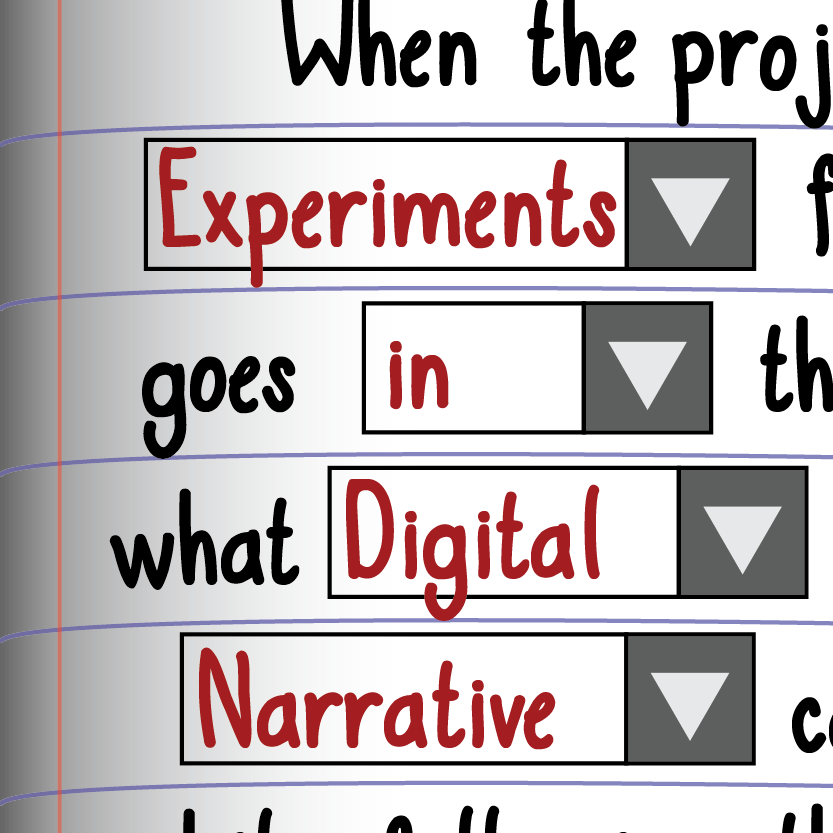
Experiments in Digital Narrative

by Tyler Beauman

Experiments in Digital NarrativeLOGO-01

Twine Shot

How many ways are there to tell a story? What does it take to tell a story? Experiments in Digital Narrative takes a look at a few potential ways to create unique stories based on user interactions.

What do you think of when you think of a story? You may think of a book or a movie or a comic, but chances are you think of a predetermined linear series of events. Sounds a bit boring when put like that. According to Tyler Beauman, “ the digital age is all about customization” and “stories should be just as customizable as anything else.”

In Beauman’s New Media capstone, users can explore three “experiments” in digital narrative to create their own stories or redesign others to their liking. One experiment teaches children how to structure sentences to create their stories. Another uses the classic fairy tale, “Little Red Riding Hood” in a “Choose-Your-Own-Adventure”-like reimagining. The final experiment allows users to create their own coloring book pages based on scenes they create using a list of characters and events.

Capstone question
In what year was “Little Red Riding Hood” first printed?

Learn more @ http://beauman-capstone.tumblr.com/

Epitaph – Press Materials

Epitaph – A Story about Human-Computer Interaction and Mortality


Leslie Hood

epitaphlogo

Screen Shot 2015-04-07 at 11.56.17 PM


Epitaph is an interactive fiction piece in which users explore their own thoughts and feelings regarding mortality in relation to human-computer interaction and attempts to find emerging cultural norms. It’s based on emerging research in a new field called “thanatosensitivity.” Users explore the story, scattered and fragmented across the internet, of two sisters who are separated by decades, by technology, and by death. Depending on how the users explore, they can learn more about the fate of the sisters and the future of someone close to them. The story is written in such a way to encourage users to think about the role technology plays in their lives – and their deaths.


When someone dies, their digitized selves live on. The internet and computers have been around for a long enough time that, inevitably, users are starting to die. When they die, so much about them is stored online, and on hard drives, and in this instance, on floppies. Epitaph is an interactive fiction told in epistolary form – with a twist.


The writings are artifacts stored on floppy disks as a long-secret diary left behind by a girl lost to suicide. The mystery of the reasons for her death, her sister’s grief and redemption, twenty five years later, are tied to these small squares, that may hold the key to healing, and to not repeat the mistakes of the past. Leslie Hood weaves technologies, past and present, with research from an infant field to bring forth a literary experience unlike any other.


“What happens to human-computer interaction when the human passes away?”


lesliehood.nmdprojects.net/epitaph (can I get a different URL?)


lesliehood15@gmail.com


Press Materials

  1. Title
  2. Creator
  3. Images for publicity; this includes you logo, images of the project and some images of users (people) using project.
  4. Icon: 200×200 pixels (a logo in png format)
  5. Illustration: 800×600 pixels or higher (usually a shot of an actual installation, performance, or screenshot)
  6. Paragraph abstract (condense your previous abstract if necessary)
  7. Press copy:
    Provide at least two paragraphs of description that could be used in an article about your capstone. You can recycle these from your blog, etc., but they should be written from a third-person perspective.
    Example: “Comic books may bring to mind stacks of staple-bound paper. But for Chloe LaPointe’s New Media capstone, comics are going virtual…”
  8. Capstone question
    This question about your capstone may become part of a scavenger hunt held during Capstone Night.
    Example: “What town boasts Maine’s only Lumberman’s Museum?”
  9. URL
    A link to your blog or, if appropriate, to the project itself.
  10. Outside email address
    I won’t use this for publicity, but if you want to me to forward your opportunities and other department-related news in the future, post or email me privately a non-First Class email address where I can reach you in the future.